Sketch: Church
One great advantage of traveling with B is that I need only follow him. As he did ten years ago, he memorizes the map of an unfamiliar city. I have only to ride behind his bicycle. To follow, watching his sturdy buttocks bounce up and down, the only constant scenery in my field of vision. I have always been fascinated by following as an emotional action: an act of entrusting, of surrendering, of indulging oneself in sensation. My shared bicycle followed B through the old streets of Guangzhou. In early July, we came to attend a classmate's wedding. That afternoon, we went to see several churches.
Summer, just after rain. Rain ready to fall again at any moment. Part of Guangzhou's charm is that the city does not hurry to eradicate the things already eliminated by time. A roadside clothing shop, closed, its name peeled away. Empty buildings eroded by the damp air. Even posters endorsed by stars from another age—a celebrity advertising a kind of diamond, a global partner of some golf team, his exclusive signature underneath. Forget the signature; no one recognizes even the printed name below it. Residents hang the poster from the fence around their yard. Together with curtains rotting upward from the bottom as if on fire, it becomes a kind of screen and receives a new life.
Meanwhile, new buildings are still being made. Green construction barriers everywhere, pasted with the Core Socialist Values, work continuing without pause. From this one can see the character of Guangzhou people. They accept a lack of unified style within a single frame. They accept that after a leaf drifts to the ground, some time must pass before it seeps into the earth.
The decision to visit a church was sudden. I mentioned Hong Xiuquan to B. Did the church where he once studied scripture still exist? At the time, his name was Hong Huoxiu. Only after learning that God was called “Yehuohua” did he change it to Xiuquan. Let's go see, B said. Perhaps some trace remains around Dongshan. In fact, none did. Issachar Jacox Roberts's chapel had vanished long ago.
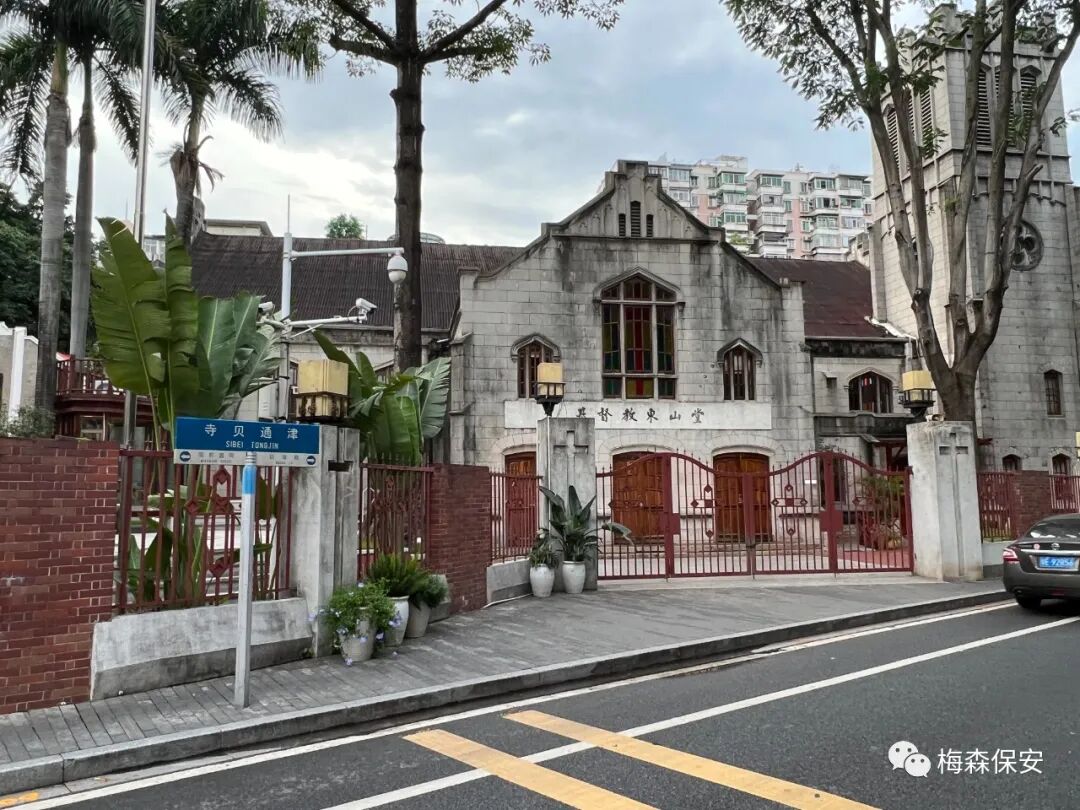
With exceptionally careless textual research, we went first to Dongshan Church. Naturally, it was closed on Saturday. I saw it from a distance along the bends of Sibeitongjin and felt a rush of recognition. I thought I had been there before. Perhaps I had merely seen its photograph many times. A small Gothic building erected by Baptists and completed in 1909, its stone walls have darkened, and the stained glass in the center is plainly a recent addition. Colored things could not survive the 1960s. Now it sits among old residential buildings, giving the architecture an even sense of breath.
Roberts, a Tennessean, arrived in Guangzhou in 1844 and built the city's first Baptist church near Dongshan. Its address can no longer be determined. Roberts possessed such enthusiasm for preaching that he was willing to lie for it. He was a poor preacher and could not secure an overseas posting, so he volunteered to go to China at his own expense, even donating a piece of land. In fact, the land was worthless. By the time people realized they had been cheated, he was already across the ocean. In 1847, his destined pupil Hong Xiuquan arrived at his church. Clearly, the student did not attract his attention. He did not even manage to be baptized. When Roberts next received a letter from Hong in 1853, his former pupil was already the Heavenly King in the Heavenly Capital, summoning wind and rain. Inside the great hall in Nanjing, Roberts was caught unprepared and knelt before the student he had once taught.
What I cannot stop thinking about is Hong Xiuquan's strange dream. Later, he used it to build a cruel kingdom of heaven on earth. It was 1837. He had failed the imperial examinations again. At home, he developed a fever. For days and nights, his family thought he would die. When he awoke, he said he had dreamed.
He dreamed that inside a golden palace among the clouds, God—whom he later discovered to be his father, which is to say that he himself was the son of God—was despondent. A God recalling the religious inquisitor in Tolstoy. Who among the people of the mortal world, God said, is not fed by me? Who is not clothed in what I provide? Yet now they worship demons.
With the sword his father gave him, Hong fought the king of hell, known locally as the Dragon King of the Eastern Sea. The cunning king of hell transformed himself into a snake, then a flock of birds. But heavenly maidens gathered on Hong's side and fed him yellow fruit. His brother Jesus was present to support him. After bitter fighting, he captured the king of hell. In the dream. A dream blending local legend, Buddhism, and the smallest pinch of Christianity.
The dream could not, of course, have been as he described it. In my imagination, he forgot it after the fever. Forgot it completely. What makes me curious is how he invented it. If religion is, in one sense, always an invention, then Hong Xiuquan's dream is a simulacrum, a copy whose gravitational pull depends entirely upon the thing it imitates. And the more this blended hallucination—acutely sensitive about the legitimacy of its own existence, because it is only the bastard child of another creation—tries to establish its originality, the closer it moves toward violence.
The modern world has no shortage of mediocrities like Hong Xiuquan who appear insane. Two years later, I am also more interested in the supporting characters of his story. One was Ye Mingchen, then viceroy of Liangguang.
The reckoning of Ye's achievements and crimes has risen and fallen with the tide of nationalism since his death. If you ask me, his contribution was accelerating the fall of the Qing with one hand. Without question, the face he presented was one of toughness and loyalty. Qualities entirely familiar to us. His toughness meant showing no mercy to his own people: within a few months, he killed countrymen linked to the Taiping Heavenly Kingdom without distinction. There were too many corpses for the carts, so they carried only ears to tally the dead. Externally, he deflected every diplomatic phrase and treated all communication, negotiation, and demands from Westerners as though they did not exist. This earned him the esteem of the war faction at court. His self-created majesty was built layer by layer through repeated humiliation of Western envoys, until war actually arrived.
When the British found him, he was reportedly trying to escape over a wall, but his large body obstructed him. He had once used that body as part of his power to intimidate; he was said to stand six feet tall. Bound aboard a British warship, he was sent to India, to Calcutta.
His second life unfolded at sea. Tied hand and foot, like A Clockwork Orange, he was forced to witness the modern world, its advancement and its cruelty—though in the latter he was already highly accomplished in the name of loyalty. In Calcutta, rumor said he was exhibited in a room as an Oriental curiosity. He called himself the Su Wu of the sea, plainly still drawing intellectual resources and self-respect from loyalty, even though loyalty no longer received an answer. He threatened a hunger strike and demanded to see Queen Victoria. Nothing came of it. He starved to death. His death possessed considerable righteousness and flashed with a certain moral light. But so what? This moral courage appeared solid and was, in fact, obscure.
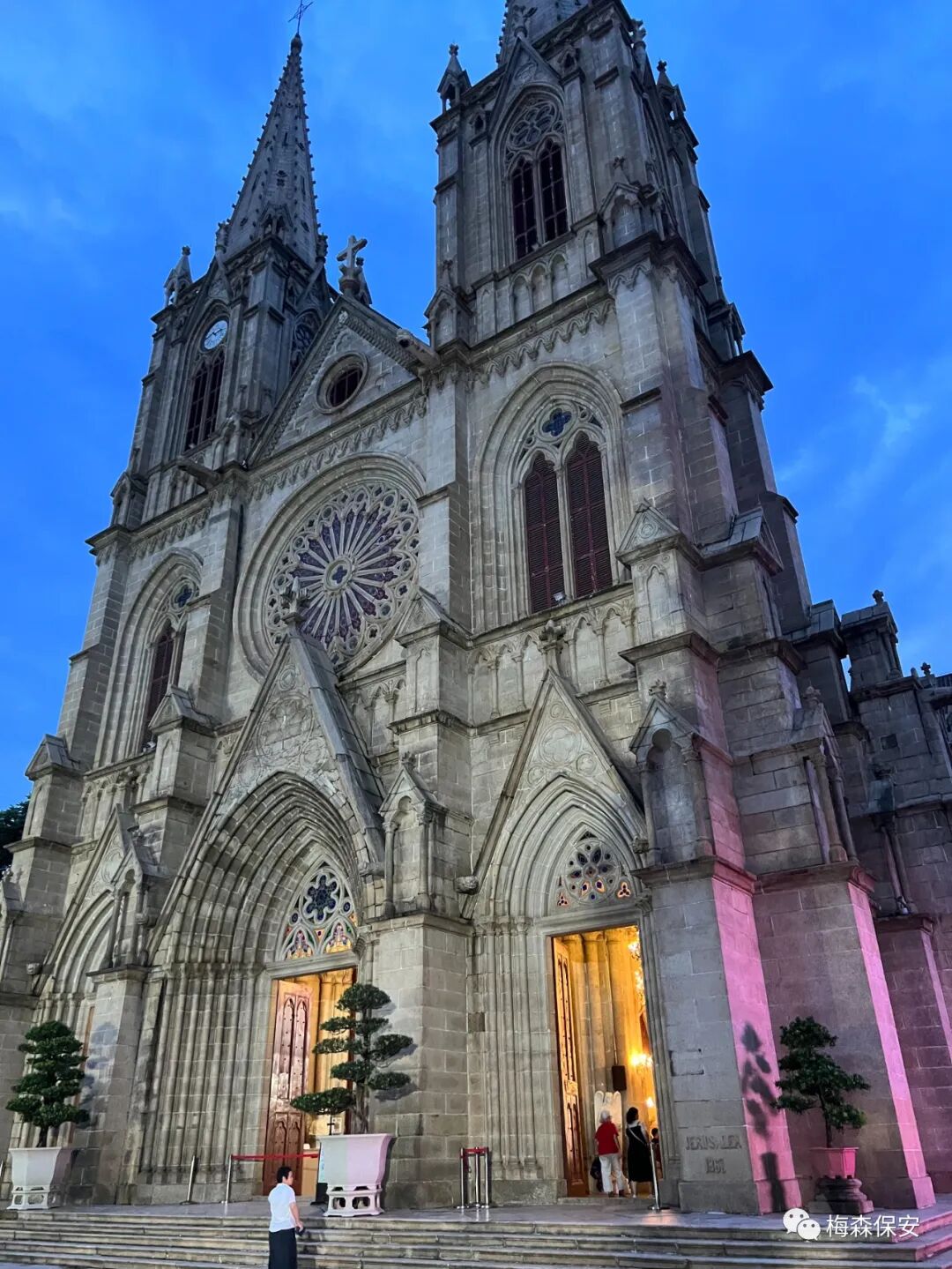
At dusk, B and I cycled to the Sacred Heart Cathedral. This church was more imposing. Construction began in 1863, the year before Zeng Guofan's Xiang Army crushed the Taiping Heavenly Kingdom. It was a spoil of the Second Opium War, unquestionably founded upon blood and fire. Later, however, it transformed many lives, transformed many conceptions of life and the universe, brought consolation, peace, or struggle, and underwent new interrogations amid the new madness of the twentieth century.
On this Saturday, it looked peaceful, brightly lit. Some great sermon or fellowship gathering appeared to be underway inside. Only a small side door remained open. A young security guard controlled entry and repeatedly stopped tourists. Only believers may enter, he said.
I avoided his eyes and swaggered straight in. B was more honest. He hesitated for an instant and was stopped outside.
I told the young guard that B was a believer from out of town, that he had come especially to see the cathedral, and should be allowed in. You're not from here either, the young guard said. Git out. Yes, I am, I said. Then what's your Christian name? What denomination? Which scripture do you read? he asked. I wanted to say John, or perhaps Joshua, but this close to God I did not dare lie. I have read the Gospel of Matthew, I said. And that other one, the, what is it. Git out! he said. Both of you git out!
We wandered the streets again, fervently discussing fruit, women, and sex—the things that could not be said inside—with a trace of rebellion. The next day, we attended the wedding, took many photographs, and talked about university. That night, we drank again. We spoke about fifteen years from now. I said what made me most curious was how people emotionally process disaster. I was writing a story about a man trying, fifteen years later, to rebuild his life in a world swept by nuclear heat and occupied by headsets.
That sounds pessimistic, B said. I think fifteen years from now will be no different from today.
That night, perhaps because I had drunk so much, I did something rare and dreamed two dreams in succession. The first concerned a large blue-green snake. It coiled through the old apartment my maternal grandfather had sold long ago. The vaporous dampness must have been the day's rain seeping into the floor of the dream. We were searching for the snake, several children and I. Perhaps I had known them in childhood and later forgotten. We kept scanning the ceiling, because once it flashed overhead like a nimble gecko. I continued looking up until the snake had silently coiled around one of my legs, and only then did I see it. It frightened me to suffocation, but I also felt its beauty. I felt some immense and irresistible force, its white-blue scales so finely formed that they shimmered. With a small knife I gouged out a piece of its flesh, profaning it. This did not stop it from drawing tighter around me.
The second dream perhaps came from several news stories about wealthy adventurers I had read before bed. I dreamed that a group of friends and I were on a coach. We were all adults, no longer young, yet were engaged in some collective spring outing. Everyone told jokes and wore an easy expression, until the bus began to sway. Rainwater, or floodwater, broke through the glass and poured inside. My friends continued to smile even as the water was about to cover them. I asked one of them where we were going. To the bottom of the sea, he said.