Sketch 6: The Bakery
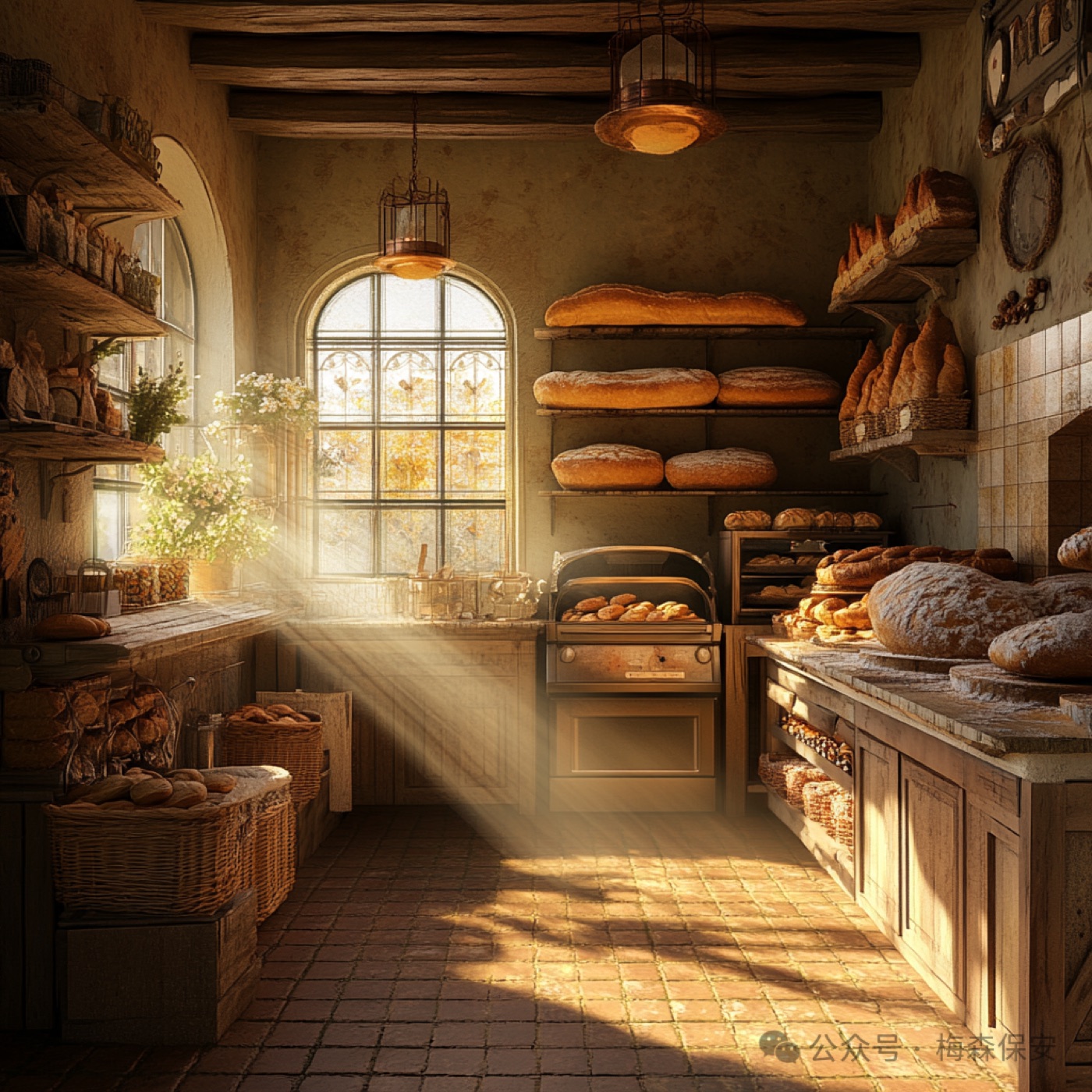
“Flour scattered into the air around them, settling on their arms, eyes, and hair.
One man kneaded raw dough,
while two others used long-handled paddles to carry it into
a square opening cut into the rear wall,
filled with flame
…
It was there, the volcano in the wall.
Do you see it? Ancash said.
Beautiful, Herakles breathed. He was staring at the men.
I mean the fire, Ancash said.”
Anne Carson, Autobiography of Red
I suddenly remembered a man who baked bread on a farm. He sat beside the oven, head tilted back. He was waiting for the loaves to come out.
I have not seen him for many years. In fact, I saw him only once, on the farm where he lived. His torso and limbs were broad as tree trunks; his eyes were two narrow slits. He said little and looked like a giant gingerbread man. He was actually an illustrator, but people said he made the finest bread. He understood the secrets that make bread rise. He gave yeast and fire patience.
A friend of mine fell madly in love with him. She confided the troubles of her heart. He said, why do you speak to me in a language I don't understand? So she laid her head in his lap.
After Grandma died, I began to take flour seriously. She once told me that hairtail would lose its fishy taste if you coated it in flour before frying. No need for extra salt, wine, or starch. After she died, I bought a jin of hairtail to cook at home—not the best kind, of course. The best hairtail comes from the East China Sea, near Zhoushan, its entire body gleaming gold with oil. In any case, I laid the fish flat in flour, the way she had.
I now know that flour molecules, because the grains are minute and full of spaces, possess a very large surface area per unit. This allows flour to adsorb the trimethylamine responsible for fishy odours. In fact, it can adsorb many things. It is all-purpose. Suspended in the air, it can even summon fire.
Grandma was a master at manipulating flour, though she did not know where it came from, nor the exact conditions and moment at which it browned or charred. In her time, a dignified distance existed between people and things. Something like cooperation, but without the demand for precision, because precision is a kind of harm.
In any case, I put the flour-dusted hairtail into the oil and fried it, the way she had. You need to give fire patience. You must not be excessively curious. If you are practised enough, food does not blacken so easily.
One evening, the smell of her red-braised hairtail drew me into the kitchen. She was much shorter than I was, and so I could see flour clinging to her forehead. I asked what the secret of the fragrance was.
Brown sugar, she said.
One day, before winter had arrived, I passed a temple. The ginkgo behind its red wall was so beautiful it moved me. Why is a ginkgo so beautiful? Beautiful enough that one would willingly suffer for it.
I entered the temple. People were gathered beneath the tree. Its fallen leaves covered the ground like a golden granary. A strong wind was about to arrive. Before it did, should we take a photograph together?
It is strange that arguments between Jesus and Satan always seem to involve bread. Satan says: if you can turn the stones in the wilderness into bread, all people will follow you. Jesus says: man cannot live by bread alone; if obedience is bought with bread, it is not free obedience.
I have no objection to their exchange. I only feel that bread has suffered a great many injustices. It became a springboard which people must vault over in order to glimpse free will. Bread became a form of coercion, like sirens, incense burners, and wine—like the many things in this world that never invited humanity in the first place, yet which humans contemptuously describe as assailants.
When a man violates a siren, the siren says, “Why not stay? Linger a while longer.” The man decides there is deceit in this, that beauty must demand a price. But the siren has merely been forced into this relationship. She hopes the man will consent, so she can convince herself that this sudden possession was reasonable, that perhaps it even has a future. Beauty is the only weight she can place on the scale.
But the man refuses her. In most stories, he covers his ears and cuts off her head, calling her a sea demon—just as, when hungry, men ravenously swallow bread, push the chewed gluten past taste buds, throat, and stomach, then, once full, call it the enemy of freedom.
Many years ago I read a peculiar hagiography about a saint martyred in the fourth century. The Romans burned him to death in an arena, but he refused to yield his faith even at the cost of his life. Over the many centuries that followed, the story was perhaps altered by many people. One gluttonous reviser described the smell released as the saint burned as “the toasted fragrance of bread drifting through the air.”
Was he hungry? Or did he believe the comparison embraced a kind of holiness?
There is indeed a sacred aspect to the relationship between people and bread, one that is not often noticed: waiting is sacred. One must wait for dough to ferment, wait for it to continue rising in the oven. Firelight is reflected in human eyes. Just as God, too, is patient with man.
Why do you speak to me in a language I don't understand? the man who baked bread asked my friend, many years ago. So my friend lay down and rested her head in his lap.
They were on a farm, outdoors. Seen from where she lay, the baker looked like a statue from an array of giants beneath the stars. He drew illustrations. He had made many drawings of her and of the farm.
Later, he took her to the bakery. Much flour. Much swelling dough. Much yeast fermenting.
Look, he said.
They leaned close to the red light inside the oven.
What is that?
That is fire.