Professor Erikson
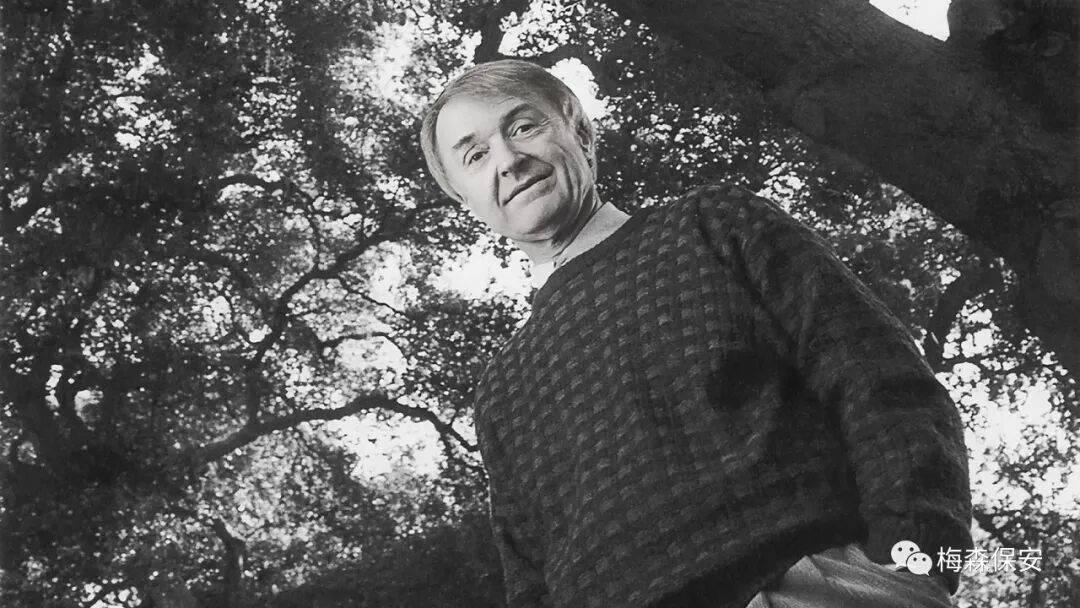
I learned this morning that he had died. The photograph in the obituary was from thirty years ago. Beneath a tree, he wears a black checked crew-neck sweater. His two eyes seem unable to focus upon the same point, so he looks toward the camera and somehow does not.
The obituary said he was eighty-three and had died of Parkinson's. He never told me that he had Parkinson's.
Our last exchange of emails was two years ago. He did not mention his health. He said only that his age and the pandemic had led him to retire from the college: “At age 80 the timing was right. I was not a fan of Zoom, and felt sorry for students who were unable to attend classes at the college.”
Professor Erikson—that was what I always called him. Others called him Stephen or Erikson, in the American habit. He was one of the very few people with whom I was willing to remain always in the posture of looking up. He was my most important teacher. Over these years, I often felt vaguely that I would never see him again. Today he is no longer in this world. No one remains whom I can look up to with such intimacy.
I went through our emails. The first I sent him was exactly ten years ago, during my sophomore year, asking whether I could sit in on his Continental philosophy course and what we would read next. He said I was welcome. We would read Hegel's Reason in History.
As always, I arrived late, charging with disordered hair into a corner of the seminar. Class had just begun. Tables on four sides made a square, Professor Erikson at the blackboard end. He placed several books to one side, sat directly on the table, and began reciting long passages of Kant and Hegel from memory. The students said nothing and began transcribing his words. I was completely spellbound.
A year later, I formally enrolled in his Continental philosophy course, then studied Heidegger with him. His classes were philosophy, but resembled poetry even more. He possessed an extinct classical quality, difficult to describe. If forced to summarize it in several inaccurate words: honesty, the gentleman, an absolute distance between the life of the spirit and the everyday. Inside his humility was a contempt for unintellectual life.
I remember that before offering an opinion, he always began, “I give my points as the following.” An expression that would never occur in ordinary speech came naturally from him.
He hardly interacted with students during class, but everyone willingly became a slave to his lectures. I was among the most fanatical. I wanted to record every word he spoke, down to the prepositions.
He did not like us using computers to take notes. As a result, I have only one set from a lecture he gave on Heidegger, on a day when I had forgotten pen and paper.
One note: “A claim was progressively made. To the extent that we can construe the world in accordance with our likings, we find it less possible to find the things that can absorb us, and for the things that do absorb us, they absorb us less and less intensely. Something major was irretrievably lost.” He was speaking about disenchantment.
On Heidegger and music: “(To Heidegger) there is a deep metaphysical historicism. Music matters, arrives, thrives, withers, fades, disappears (not timeless)… Imagine a world, a post musical-period, where a form of music is no longer vital, no longer speaks to us, yet no form has yet taken the place of music. We can only recycle what has been and ‘manufacture.’ A glimmer of what we might need isn’t here yet.”
At the time, I inhabited a state of self-exile, perhaps much like the present. I had not written for a long time. I often called in sick to class even though my body could hardly have been healthier. I was afraid of every activity connected to social life, especially events and parties. Usually, I took a slice of free pizza and left. With every exam, I discovered only when studying the day before that I knew nothing. This included Erikson's Continental philosophy course, because I had failed to finish every original text. Under pressure during a philosophy exam, I imitated Spinoza: established several mathematical axioms and forcibly derived propositions from them. They were plainly full of errors, but this allowed me to cite fewer things I had not read.
Some time after the exam, Professor Erikson called me into his office.
“Have you considered doing work in philosophy in the future?” he asked.
I said no.
“There is a gift in you,” he said. “You must take hold of it.”
It was one of the most important moments of my life. I cannot describe the shock it gave me. I had already abandoned the creative life. From that day onward, I felt assurance again. I began writing once more and considering the things that genuinely mattered to me. Today, as I again fall into the same self-exile—making excuses to avoid taking hold of my creativity—I remember that moment. Professor Erikson is no longer in this world.
I visited his office from time to time. We discussed philosophy, future paths, and various wild thoughts. I can no longer recall the specific conversations. But he never belittled any choice of life plan. A profitable path or a scholarly one seemed all the same to him. Nor did he sell you a story about how important philosophy would become in your future life. His only expectation was that a person live an intellectual life. This included independence of thought, honesty, and a form of character. Generously, he believed I was already practicing such a life, though he also reminded me that people could change and lose it.
People say that in his youth, he was witty and cutting. “Erikson was not afraid to be hard on me,” recalled alumnus and senator Brian Schatz. Shortly before graduating in 1994, Schatz submitted a mediocre paper. Professor Erikson wrote: “Brian, we both know you are better than this. That is all that matters.”
In old age, he smiled at everyone. For me, he had endless tolerance and encouragement. At graduation, he asked me to stand beside him and translate for my father and grandmother: “I have taught here for fifty-three years. Your child is among the five best students I have ever taught.” Dad said, “Wow, wow, thank you, thank you.” He and Grandma gave the professor thumbs-up and repeated the story for days afterward.
Later, a journalist friend wrote an article about my book. I had mentioned Professor Erikson in it, so she contacted him to ask how he saw me. Today, I told her that he had died. She sent me his answer from six years ago.
“When Zhonglun attended my philosophy classes, I noticed from his written papers and exams how intelligent he was and that he had a gift for philosophical reasoning.
While a student at Pomona College we had many conversations in my office, and I always looked forward to listening to his observations. Our conversations were wide-ranging, from philosophy to literature, and to the cultural trends emerging in the twenty-first century. We didn't always agree, but when we saw things differently we would explore our differences and sometimes even change each other's views. It was very stimulating.
I always found Mr. Sun a thoughtful listener. He clearly understood the fine distinctions in philosophy. He came across as a very mature student, wise beyond his years and very self-possessed. Both of us were very concerned to explore the general direction and implications of European Thought.
Mr. Sun is quite special in ways not easily explained. He obviously is someone who thinks much about life and the opportunities that are available to us as human beings. I always urged him on to be an independent thinker. I was not surprised that Mr. Sun published a book, but was surprised that I was mentioned in it.
I believe that Morris is making a good academic career choice by getting a degree in the Social Anthropology. Maybe I would have wished that he would have gone into the History of Ideas, but this field is not very robust, and Morris interests are more centrally in the present, not as much in the past.
I expect that Mr. Sun will have an engaging and adventuresome life, balancing his intuitions and intellectual gifts in relation to each other. I suppose my basic hope and expectation for him is that he continues to develop as the Morris Sun I came to know.
He is very special.”
We remained in contact after I graduated. One exchange of emails a year. Each time, I was doing a different job, describing a different enormous creative plan, and continuing to publish abuse about the world and society. His replies always avoided the violent parts. He did not deny the decline of history, but he was more interested in my experiencing and witnessing the growth of individual life. The final sentence of his final email still urged me to write: “I wish you well with everything you encounter, Morris, and please keep on writing. You have a gift.”
He always gave me strength. The parts where he gave me strength are also the only parts I remembered. Rereading the emails today, I noticed scattered paragraphs about himself. I had neither paid attention to them nor replied.
About his health. In 2018, he said the life cycle had its own way of arranging things, and that he now fell into retrospect more often: “Things are largely fine with me. The life cycle has a way of determining certain aspects of our agendas, and I am in a very normal mode of retrospect a little more of the time than before.” He must already have known then that his time was limited. When the pandemic began in 2020, I asked how he was. He lied that although their age placed them at higher risk, he and his wife were both healthy: “Our age puts is in the higher risk factor, but we are both healthy without underlying issues.” In 2021, he answered only my confusions. He did not mention his health again.
The beliefs he held also collapsed during these years. In one email, he said that everything happening in the twenty-first century had profoundly destroyed a narrative once so meaningful to him: a journey from Kant and the Enlightenment to Heidegger, including his life's work on ways to reground the human spirit in a new history. But the events of our age had ended this way of thinking, not merely paused it:
“Events of the twenty-first century have seriously disrupted a narrative that had made so much sense to me, the journey from Kant and the Enlightenment through Heidegger, and much of my own work involved exploring ways of absorbing and moving beyond Heidegger, a way of re-grounding the human spirit in the context of a newly emerging history.. But the events of our time may have brought about an end to this way of thinking, not just a pause.”
He once said that he would no longer vote because he no longer trusted the basic rules of the establishment and would not preserve himself as a broken tile. We argued about it. Later, I expressed interest in anarchist theory. He did not answer. Perhaps every ingenious political scheme, to him, only consumed the vitality of the central question. It asks: What matters in life? What has meaning? What is meaning? Toward what are we to be led? Answering requires courage and no detours.
When I graduated, I sent him an email. We were about to leave, I wrote. If there were something he would have graduates keep in their hearts, what would he say? His thoughts on this probably changed daily, he said, but today they were:
Embracing the strange may often be liberating.
Better to live hopefully than to arrive.
Being open to the present is more fulfilling than reflection on the past or projection of a future.
Without compassion and gratitude we diminish.
Taking risks is the price of embracing opportunities, and it is worth paying.
One of the greatest gifts life offers may be anonymity.
Some of these I have done. Some I have not done at all. When I was in America last year, I imagined visiting him at his small house in Southern California. Beneath a persistent unease, I prayed that he would remain healthy and give me a little more time to prepare an honest state. Honesty sufficient to negate one's life and path completely requires time. Usually, time runs out.
The world has become worse. For a long while, it will continue to worsen, inciting what is evil in people and testing the endurance of nature. Until pain can no longer be dissolved by numbness, people will be forced to face themselves honestly again. Human history will complete another cycle. New hope will begin to climb. Another old man I respect once wrote to me: “Play the part you should in the future struggle between good and evil.”
My life may be only a footnote during history's fall, just as Professor Erikson's life came to rest in an age without gravity. But that does not prevent the longing for, and possibility of, a noble life.
In every exchange, we told each other what books we were reading. He once recommended a popular book of philosophy called All Things Shining: Reading the Western Classics to Find Meaning in a Secular Age. It ends with a parable:
Two students had studied for many years and were about to descend the mountain. Their master told them: If you discover that all things in life are shining, you will be happy.
Many years later, the two students met. They could not wait to tell each other about their lives.
The first student said: I am unhappy. I cannot discover all things shining, because so many terrible things happen in the world.
The second student said: Not everything is shining, but everything that shines is.
Professor, you are one of those things that shines forever. You are there whenever we look up.