Portrait 7: Fire
Every so often, we go to the south side of the city to visit her parents. It is far away. Apart from hikes or trips between cities, I have almost never spent so long in transit. You ride an entire subway line. When the train leaps back above ground for the last few stops, the city has taken on a different face. More expansive. Less crowded. The sunlight seems to pass through a filter full of sand, laying a quiet film of gold over things and making them look more deeply lodged in the past. All the buildings are low and old. Obsolete factories. Family housing left by the state-owned enterprises of another time. Her home is in one of those buildings. She grew up here.
She had a beautiful name. It made me think of fire.
Whenever we visit, her parents prepare a great deal of food. Grapes, pineapple, blueberries, spread across the wooden table in the living room. Bags of loose nuts picked out at the supermarket. From the moment we arrive, her father watches the clock, calculates the time, then goes into the kitchen and begins putting the tableful of prepared ingredients into the wok. Don't help, there's no need, I'll just fry these up, it won't take long, you stay out there and talk, wait for dinner, he says. And her mother says, don't be polite. We only cook so many dishes when you come, and then we get to have a good meal too. Usually we just eat whatever.
Nothing in her home changes from year to year. The whole apartment still has the look of the early 2000s. It seems that, from a certain point on, they stopped adding new furniture. But the rooms remain immaculately neat. So the plain sofas, the wooden table and chairs, look merely out of fashion, not old. Her mother grows succulents that spill from their pots. In one corner of the sofa sit red stuffed animals corresponding to the signs of the lunar zodiac. One more appears every year.
She was one of the most beautiful girls in our few graduating classes. Certainly the sexiest. People would ask how a face like that, that tiny waist, those breasts, those long legs, could all belong to one person. She had great waves of hair too. I remember that her lipstick was always a brilliant red, holding nothing back.
It is difficult, then, to imagine that she grew up in such a humble family. Her father—from whom she inherited something around the eyes and brows—always wears the trace of a smile and speaks softly, even in the moments of greatest grief. Her mother does not say much, but when she does there is a faint tremor in her voice, the kind you hear in someone who has been hurt, or someone utterly unworldly speaking to outsiders. Last year she developed terrible pain in her lower back and could hardly bend over. After a year of moxibustion, she is better now. When she lays out the chopsticks, she has trouble matching two of the same color and must hold them close to her eyes. They have both plainly grown old.
Her mother asks how some of our classmates are doing. This one is about to leave Beijing. That one is starting a business and has never been busier in his life. How wonderful, she says. It is wonderful to be young. What about you? she asks me. I am not working at the moment. I am resting, and thinking about making something of my own afterward, I say.
Wonderful, wonderful, she says. What a good age this is. Young people have the chance to be themselves. Back then, she says, when she tested out of a mountain village in Qinghai and into a university in the south, the train ride took fifty-three hours. Later, when jobs were assigned, she put down Beijing and nowhere else, because there was a direct train home and it only took a dozen-odd hours. So your uncle and I are born-again Beijingers, you see. All we could rely on was ourselves, right?
I have almost forgotten where our lives crossed at university. I remember harboring an unkind stereotype, perhaps born of my own insecurity: that a Chinese girl as sexy, popular, and poised as she was—a girl everyone wanted—could easily work her way into American life by playing a few simple games of emotional give-and-take. In fact, she had a boyfriend in Britain. They were together for many years, most of them long-distance. She seemed to love him until the very end.
I often saw her in photographs: three or five girls in a row at a party or on a hike. Even when she bent down amiably, she made the people beside her fade a little. She studied at the school next to mine. We did not see each other often except at large, noisy dinners for Chinese students. Once, before we knew each other, she suddenly leaned into view from the side of the round table and asked, "Hey! What do you study?" She took a guileless interest in people. Many who spoke of her called her a real Beijing girl—a bright, big-hearted, unguarded kind of woman. Less prone to sensitivity and suspicion. You did not have to worry too much that a stray word would wound her.
We had both taken a year off, so we still graduated together. It made us some of the oldest people there; she was even a year older than I was. By the time we returned to school, neither of us knew many people anymore. She asked me to lunch once, perhaps twice. In the dining hall, younger students discussed Plato, alcohol, marijuana, dates, internships, changing the world, while we vaguely calculated what to do after graduation. I said I would continue studying. She said she planned to go home. She had, in fact, posted about it on WeChat Moments, but I had not noticed. During that time her maternal grandfather had died. She wrote:
The call I had with him the day before I left keeps echoing in my head. Again and again I nagged him to look after himself and wait for me to graduate and come back to see him. Ever since I was little, I imagined that after I graduated, found work, and started a family, I would visit my grandparents and let them see that I was happy. I never thought Grandpa would break his promise. He won't get to see it. Maybe it is a sign, telling me to spend more of our limited time with my family. So after questioning myself more times than I can count, I have decided to go back to Beijing after graduation. My zodiac year: a year certain to bring all kinds of challenges and changes. I really am afraid, but I have to pull myself together and face it. A little at a time. Everything will be all right. It will be especially all right.
Life did not get better. After returning to China, she worked for a while. Then she fell ill and received the diagnosis. A year later, she spent her birthday in chemotherapy. She made a wish: "To be happy today and every day after."
Perhaps I understand why her family never replaced the furniture: her room remains exactly as it was. It faces south. Outside the window are an immense blue sky, another silent block of workers' housing, and the reflections of succulents along the sill. On the shelves, the books of her childhood and adolescence are still arranged in neat rows: Standard Dictionary for Primary School Students, Techniques for Writing Narrative Essays, General Mathematics Olympiad Textbook. The Snoopy toys she collected. Her pink piggy bank. An academic certificate. A photograph with her host family abroad. A photograph that may contain her, carefully covered from view.
Her desk. A delicate pen holder and a little globe still sit tidily in the upper-right corner. Her parents must have dusted them with care, because even now they look new. Beside the desk is the timetable from her first year of middle school, Monday through Friday. I find it difficult to picture her as a child, to imagine how a heart of fire grew inside this plain, orderly, slow-moving room. Her earliest Facebook photograph was taken when she was sixteen. By then she had already grown into a tall beauty. When posing with other people, she would kindly crouch down and bring her face close to theirs.
One night in our final undergraduate year, we gathered in a dormitory common room to play games. I was preoccupied with a paper and went back early to sleep. I later heard that they had played Fuck, Marry, Kill. A boy had to choose, from the girls present, one to fuck, one to marry, and one to kill, and explain his reasons. She was the one he chose to kill. Why? No one remembers.
We fell out of touch for a while. Like many friends you never knew especially well, she walked out of my life in silence. My own path, after all, was still unresolved. New people entered; new ideas came surging in. In a basement in Cambridge, I spread a table with research papers and a thesis containing zero words, put my feet up on a chair, and idly scrolled through Moments. I saw a post for her birthday: a video greeting from Wang Leehom. Looking into the camera, Leehom gave her a long-distance embrace. "Happy birthday. Get well soon, and then we'll bring the concert to you." Our mutual friend J had found Leehom and arranged it as her birthday present. Scrolling farther, I saw her say that she was undergoing chemotherapy:
On the first day of being twenty-five, I received so much love. It makes me want desperately to live—healthy and happy—to go where I want to go, do what I want to do, love whom I want to love, and experience more beauty.
Birthdays mattered greatly to her. Before and after chemotherapy, she wrote a birthday reflection every year. She thanked her friends and her family. She also wrote sentimental little essays for her parents' and boyfriend's birthdays each year. Her father was "my tall and handsome dad, my kind and upright dad, the hero in my heart whom nothing can defeat... Dad, no matter how old I grow or where I am, I will always be with you." She thanked her mother for bringing her into the world, for giving her her eyes and the color of her skin, for teaching her to be a kind and independent woman. "I know I am not the daughter you hoped I would be... But I want you to know that being your daughter is the luckiest thing in my life. I would not trade it for anything."
The love between them must have had enormous weight. To pay for her education, her mother says, we sold the only other apartment we owned. What else could an ordinary family like ours do? It is not as if we were rich. Then her mother says, though really, who knows what rich people's lives are like now? Last time I ate with a classmate, I only learned over the meal that she owned more than a dozen apartments around here. But she still packed up the leftovers when she ate out. She was very frugal like that. In the kitchen, her father is still stir-frying while her mother moves back and forth helping him. By accident, I call one of my companions by her name. Everyone goes still for a moment. Then we carry on.
After graduate school, I returned to China. At the time, I thought I was merely taking a short break before my PhD. I heard she had improved, left the hospital, and begun working. In Beijing, we made plans to meet at the school where she worked.
It was summer. When I saw her, she was still as beautiful as before. I do not know whether she wore a wig, but even her hair looked as lovely as it used to, as if illness had left no trace at all on this body. She walked around the school with me, pointing out one thing and then another. She told me she had become a counselor. After falling ill, she had reconsidered what mattered and what did not. Her old life at an advertising agency had no value at all. Now there was so much she could do. She herself had attended this middle school. Many of its students had mental-health problems, and now she could help them. Seeing you like this makes me so happy, I told her. I am happy I get to see you here again too, she said.
A few months later, I heard she had relapsed. She said being ill was so hard. She could hardly hold on.
I was in another city and asked J to find out how she was. Sometimes better, sometimes worse. One specialist said this, another said that. Things that now seem wholly unimportant entangled me, and I kept postponing my visit. She began taking morphine and started chemotherapy again. On Moments, she posted a plea for help: "More than anything, I long to live an ordinary life like a normal person. Thank you." When at last I reached her hospital, climbed to a crude little attic room, and pushed open the door, she could no longer speak. Her eyes were closed. She breathed with difficulty, as if she lived in a world being roasted alive.
It was there that I met her parents for the first time. Her father told us she had lost consciousness. When he walked us to the door, a faint smile rose on his face, plainly marked by tears, as if he were trying to comfort us. We have done everything there was to do, he said. You should go home early and rest. We are here, so it is all right. We may have to trouble you with what comes afterward. Her mother, already showing the beginnings of a tremor, sat by the bed and stroked her hair.
We stayed nearby, on call. She did not have many friends in China, after all, and fewer male friends. We were in a beef-noodle shop when J sent word that she was slipping away. We called a taxi.
There is apparently a custom that on the day white-haired parents send off a black-haired child, the parents must not be present. Otherwise the child's soul will not want to leave and cannot go to heaven free of attachment. I think that, no matter what, she would not have wanted to leave this world. She loved it so much. In any case, we followed the hospital's all-in-one funeral service to a nearby morgue. I remember J had to sign on behalf of the family. He had been away from China too long. He turned to me and whispered, how do you write the tong in tongyi, "consent"? I shook my head, gave a helpless laugh, and traced it for him in the air. Realization dawned. Oh, oh, I remember now. Fuck.
We were all too young then and had no experience of death. As for death and funerals, I was comparatively precocious. After J spoke, he asked me to lead the proceedings. In the back row, an older man, apparently an old friend of her father's, stood perfectly straight. At the end of each stage, he called out her name in a firm, ringing voice, giving the rest of us courage to continue. Before we left, we went forward to see her one last time. She was still so beautiful, and more at ease now. They had made up her face. She looked as though she were dreaming.
After the funeral, several of us who had not seen one another for years talked outside. It felt like a debrief: what we had done, what could not be done, what perhaps we could have done sooner. We spoke about how she used to be and told little fragments of her. Some laughed, some cried; more were struck silent. Then we parted. Life went on. She alone remained there.
From time to time, J organizes a visit to her parents. Our schedules are always difficult to align, so each time we put it off and put it off until only one or two people go. Everyone has a life to live. One clear fact is that her life has grown ever thinner within ours. With every visit, we confirm that the impression she left us has grown fainter too. We have a tendency, with the dead, to abstract them into a symbol within our own lives, until all that remains is a sound, a word, an expression. One day, perhaps, she will be condensed into a ball of fire. Anne Carson says we are all neighbors of fire.
Her parents like having us there. They message me: come over if you are free this weekend. It is far, yes, but a new subway line will open someday, so you will not have to circle the whole city. From the station you will be able to take such-and-such a bus straight to the entrance of the compound. They treat us as their children, as parts of her. We, too, are willing to perform the appearance of lives growing vigorously forward, as if some portion of her ardor continued through us. At the dinner table, we do not say her name. Her father walks us downstairs. He looks as if he wants to say something, then draws the words back and only pats us on the shoulder. Goodbye. Come often.
Someone asks if I knew her well. I should answer honestly that I did not. But the friends who make these visits were not necessarily the friends closest to her when she was alive. Everyone has a way of keeping vigil for the dead. Or perhaps she disappeared completely from some people's lives, which would hardly be strange. But our friendship may have become firmer after her death. I feel a quiet loyalty toward her. It has no foundation and has never placed any demand on me. Yet when I think of her, think of her breath once meeting fragrant flowers, of the ends of her hair once settling softly on leaves, of how she once set certain souls alight and let her own heart burn, I feel the truth of my own love and sorrow.
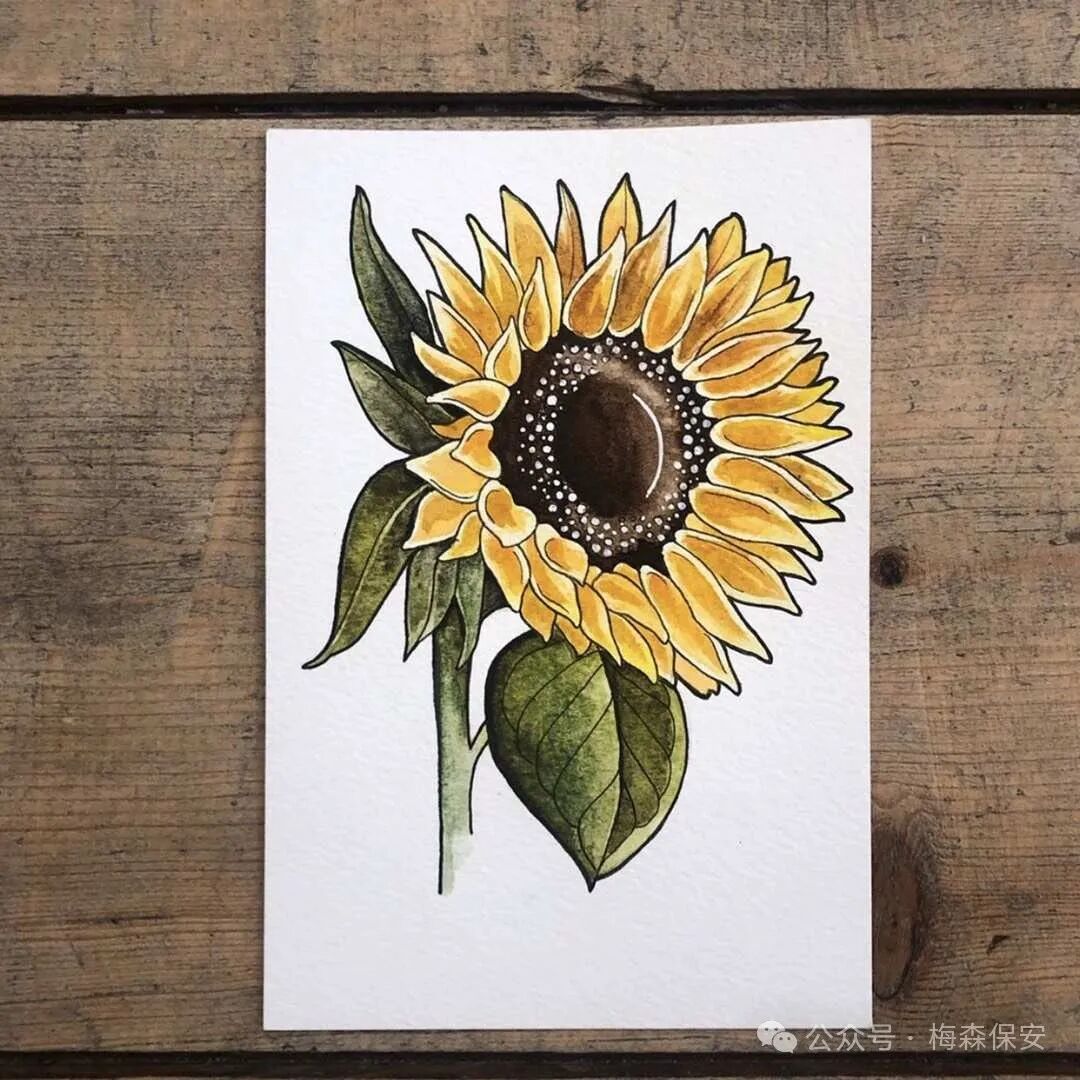
Her final post on Moments was a sunflower she had painted herself. She said, "Love you all." I learned later that she loved sunflowers, that the stubborn vitality of a sunflower resembled her own. By then, she must have known she had little time left. These were the last words she left the world. Sometimes, when I am alone, I think of the people who have already left my life and wonder whether they might be said to have died at a good time. This is, after all, a world in a downward plunge, diving toward the abyss. Our lives will be tested. We will be forced to adjust what we expect of the future. We will discover that we happened to live inside a single breath taken by human civilization; that the breath is almost over; that human civilization itself is only one infinitesimal future ruin in this physical world. But whenever I think of her, I think of certain deep, unrestrained breaths, of struggle, of a longing for beauty. I think everyone still dies far too soon. They should all have had one more look.