Portrait 6: A Foggy Day
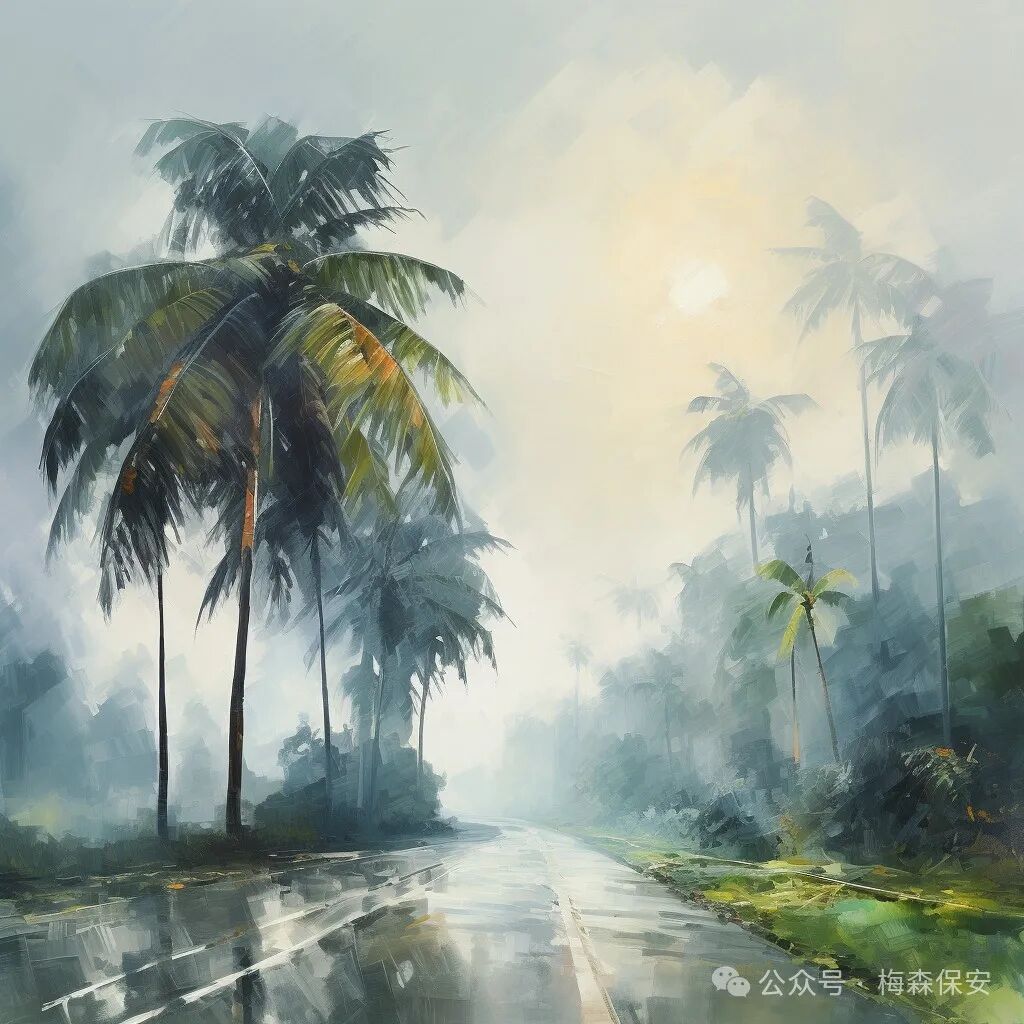
On a foggy day, speeding along one stretch of Hainan's ring expressway, I remembered again what it felt like to love someone. Coconut trees appeared and disappeared in the distance, an ink forest still gathering itself. I remembered the girl saying that as a child she had loved The Lion King, that the story moved her to tears. We often watched films together. She cried easily but made no sound. Sometimes, when the film ended, I turned to find her eyes red, tears clustered around them like droplets on a newly folded umbrella.
She loved the intricate patterns of Central Asia and magnificent illuminated manuscripts like the Book of Kells, yet what struck her was always some simple thing or impression. Sometimes we lay together on the dormitory bed looking at the fan overhead, and she told me stories from childhood. She spoke of an aunt whom people rumored to be a lesbian. In any event, the aunt was unruly: in that era she got tattoos, drank, rode in the cars of men from society. But once, the aunt came home. The girl said she would always remember her entering the bedroom at dusk, smiling at her, then turning her back and unfastening her bra. Later the aunt disappeared. Some said she used drugs. Some said she called the family from a fraud ring. In any case, her parents died with bitterness in their hearts. Yet what she left the girl was this beautiful impression at dusk. It was so powerful that I felt I could see the curtain faintly moving beside the bedroom window, and a shadow swallowing the aunt's spine like an eclipse.
I had booked a rideshare. The anxious driver stopped at every intersection to ask people crossing the road whether they were going to Haikou. Two women in the back spoke a dialect I could not understand. This year, I am about to turn thirty. Back then, we had only just entered our twenties. She described how she imagined herself at forty. “Living alone in an old house. Maybe after some major illness. Divorced, no children.”
You don't have to imagine it that way, I said.
It doesn't matter, she said.
She possessed a genuinely leftist temperament: introverted but extraordinarily brave, impulsive, with an obsessive tendency to romanticize suffering and the weak, like Simone Weil. As a child, she said, her ambition had been to become a prostitute and provide free sexual services to migrant workers. The first time she came to my place, she said, I don't like you anymore. It's too clean here. Perhaps a powerful tension always existed between our personalities. While I worshipped her, stray words from her often offended me; because she was more talented and more eloquent, the offense often rose to the level of dignity.
Once, for example, we debated love. I said that the love I believed in ought to appear within everyday life. No, she said. The love she longed for must concern the soul. She would love me forever, but forever was not a concept of time. It was an intensity. In truth, neither of us had much experience of love then. We liked using words such as ought and must to guide our behavior. After every time we made love, we spent even longer discussing how our bodies had felt.
Her idea of love wounded me. I believed it meant she could not endure vulgar love, the residue that occupies most of our lives. I described myself as a future victim. In the end, you will abandon me, I said. You will find a new intensity, a new resonance, because—the part I did not say—I approached you as a worshipper, and eventually you will grow tired of me. I accused her of a one-sided and conceptual love that would lead to self-destruction. The more violently a thing burned, I said, the faster it withered. I even invoked Aristotle: moderation alone was virtue and could, could, what was it, last. Embarrassed, I lowered my voice on the final word. She looked up at me with a sly and arrogant expression. So what? it meant. Listen to yourself. I turned my head away.
Many years later, we sat in the café of a bookstore. She wore a baseball cap, still with heavy eye shadow and dark lipstick. We had not been in contact for several years. For the first minute, we both spoke little and studied one another carefully.
About what I imagined, she said. I heard you're doing pretty well, earning a decent salary. I always thought you actually needed a comfortable environment before you could write what was yours.
Hah, I said. You look a little more weathered than before.
Me? Where?
Your face? And you're still too thin.
I remembered how she used to gaze into the mirror for a long time, entirely aware of her own beauty. I also knew what words could easily hurt her, one of the pleasures available after separation.
I told her that, under her influence, my conception of love had reversed completely. I now accepted that I would love different people over a lifetime, and love different people at the same time—only, the sensation of love was indistinct. Perhaps beauty alone was certain in this world, while love left a person bewildered.
You're wrong, she said. I never tried to love many people. That was you. I have always been looking for the singular love, the one love in a lifetime.
Did you find it? I asked.
I already missed it, she said.
I observed her eyes. They had once been the most enchanting, seeming to contain more water than other people's. Even when she was not crying, they shone like a mirrored lake. The lake could always reflect more colors, preserving those breath-stopping impressions of beauty. It often made me imagine what she had been like as a child, what those fluttering eyes saw during her silences or while she spoke words of flattery.
Now, perhaps because I no longer loved her—and naturally, she no longer loved me; her love had remained inside that powerful moment called forever—her gaze no longer seemed as clear as before. She, for her part, accepted the changes in her body. What she always said was: Then that's how it is. I don't see any meaning in being healthy or living a long time. Anyway, I said, I feel that I have grown younger in the past two years. Actually, she said, men are even less capable of accepting their own aging. The male fear of aging makes me wary.
We had confirmed the decline of our passion and could therefore speak about the past. She proposed that each of us name the most powerful moment we had shared.
You must know mine, I said. You changed me in that moment. You know that, right? My beliefs were different afterward.
You've said it many times, but I think that moment was ordinary, she said. Do you know mine?
I know.
What was it?
Are you testing me? Did you ever tell me?
I did.
Then tell me. I'll see whether we're thinking of the same one.
You've definitely forgotten, she said. I knew it.
It was the day of my graduation, she said, when we walked together through a garden. For a hundred years, graduates had carved their names into its walls. Some had painted murals of their classmates. Walking through that garden with me, she felt blessed by history precisely because we said nothing at all.
The car left the expressway and entered a web of streets. The two women behind me stopped talking and sat upright, as though waiting for something to happen. New Year was almost here. Across this sweltering island stood merchandise in great red New Year themes. In a narrow lane, a white plastic bag lay spread like a wedding dress, repeatedly run over by delivery riders on electric scooters.
That sensation of love disappeared again. I had not yet managed to describe its shape. Fortunately, I had made some notes on my phone and would soon write it down while eating qingbuliang and sour zaopocu soup with friends. I remembered what I had confessed to her and to several other people: I cannot feel love unless it has passed forever. Love rekindled only in memory is very likely a narcissistic hallucination. I accept that. I would swallow the hallucinogenic pill, if one existed.
She did not like going out. She did not like eating. She despised the appetite of the mouth and belly, despised shallow pleasure, the complete opposite of me. But once we went outside, she trusted me blindly. One prank I enjoyed was telling her to turn right after we left a restaurant, then walking left. She would continue for a dozen steps before looking around, turning back, putting her hands into her pockets with a helpless expression, and sprinting toward me.
In Dali, we rented an Aima electric scooter and raced along the road beneath the Cang Mountains, not headed anywhere in particular, passing trucks, cars, and cattle all the way. Goodbye, Brother Truck! Goodbye, Brother Car! Goodbye, Brother Cow! In the rearview mirror, I saw her arms around me, her face turned to the side to watch the black mountains towering into the clouds. Then, clack, the footboard fell off. We stood beside the scooter in contemplation as Brother Truck, Brother Car, and Brother Cow passed us again like the tortoise overtaking the hare. Finally, she removed her hair tie, bound the footboard to the scooter, and we limped back to the old town.
At our third meeting, she wore a yellow dress. Whenever I called her name, she looked as though startled awake from a trance, just as, later, when I lied and told her to go right, she always instinctively walked forward for a while. Perhaps in many moments she was not attentive to the present either. Perhaps she was more easily bewitched by hallucination than I was. Aren't genuine leftists all like this?
But at our second meeting, when we had walked through the middle-class streets of Los Angeles that filled her with disdain, past a pizza shop with false flames burning at its entrance and a gym, and sat beside a flower bed, I could feel her watching my profile with such concentration that I did not dare meet her eyes. I looked up at a crane to the upper left. I thought I would remember the string of English branding along its arm, but of course I forgot. At the speed Americans worked, perhaps we could return several years later and still find it there?
At our first meeting, outside a concert hall, I saw her in the distance with her shoulders hunched, looking at her phone or something. I walked over.
I have unfortunate news, I told her. Today's student tickets have sold out. The cheapest seats are now one hundred fifty or one hundred sixty dollars. Maybe we can just walk around the neighborhood?
How have you been? I asked her every so often. Usually, somewhere between one day and a week later, she replied, Fine, demonstrating no enthusiasm for the question. Information about Pamuk, Zhang Guangtian, cats, and Disco Elysium received an instant answer.
After we separated, we had no contact for several years. Occasionally, I asked friends whether she was still alive. More time passed. One day, I called her.
How have you been?
Fine, she said dismissively.
Could you forgive me for not contacting you for so long?
So you know you were wrong, she said.
Then there was Shanghai, shortly before restrictions were lifted. Everyone was in the streets, bodies pressed against bodies. I heard she was there too, so I arranged to meet her at a subway entrance and asked her to bring me a power bank. By then, most people had scattered and fled. The station entrance was sealed. I paced beside it and waited for her. I remembered that whenever we went out in the past, I generally waited at least an hour.
She arrived in a baseball cap. When had she begun liking baseball caps? Surely she wasn't going bald. Otherwise, she appeared little changed from several years before.
Here. Your power bank, she said, handing it to me. You all right?
Fine, fine, I said.
She nodded. My boyfriend's behind me. I'll go, then?
Sure, sure. Take care, I said.
During our final days together, we seemed always to be waiting for the end to arrive. Sometimes she sat beside me and said, I think one day I will marry suddenly, to someone I don't love that much. I, meanwhile, lay beside her and opened Pornhub as though no one else existed, attending to my own business.
Finally, one day, she asked to separate. I ran into her living room and kicked over two boxes. Then I returned to her bedroom and begged her to pretend one final time that she still loved me as before. At dawn, I would leave.
At dawn, I packed my luggage.
Goodbye, then? I said.
Thank you, she said.
She took me to the airport. I asked whether we could remain friends.
Yes, she said.
Could we go on bearing witness to each other? I asked. To me, bearing witness matters more than romantic love.
Yes, she said.
I was about to enter security. When I looked back for the last time, she was wiping both eyes with her hands. Quickly, she turned her back.
The fog never lifted. The weather was about to turn cold. Happy New Year.