Portrait 11: The Game Console
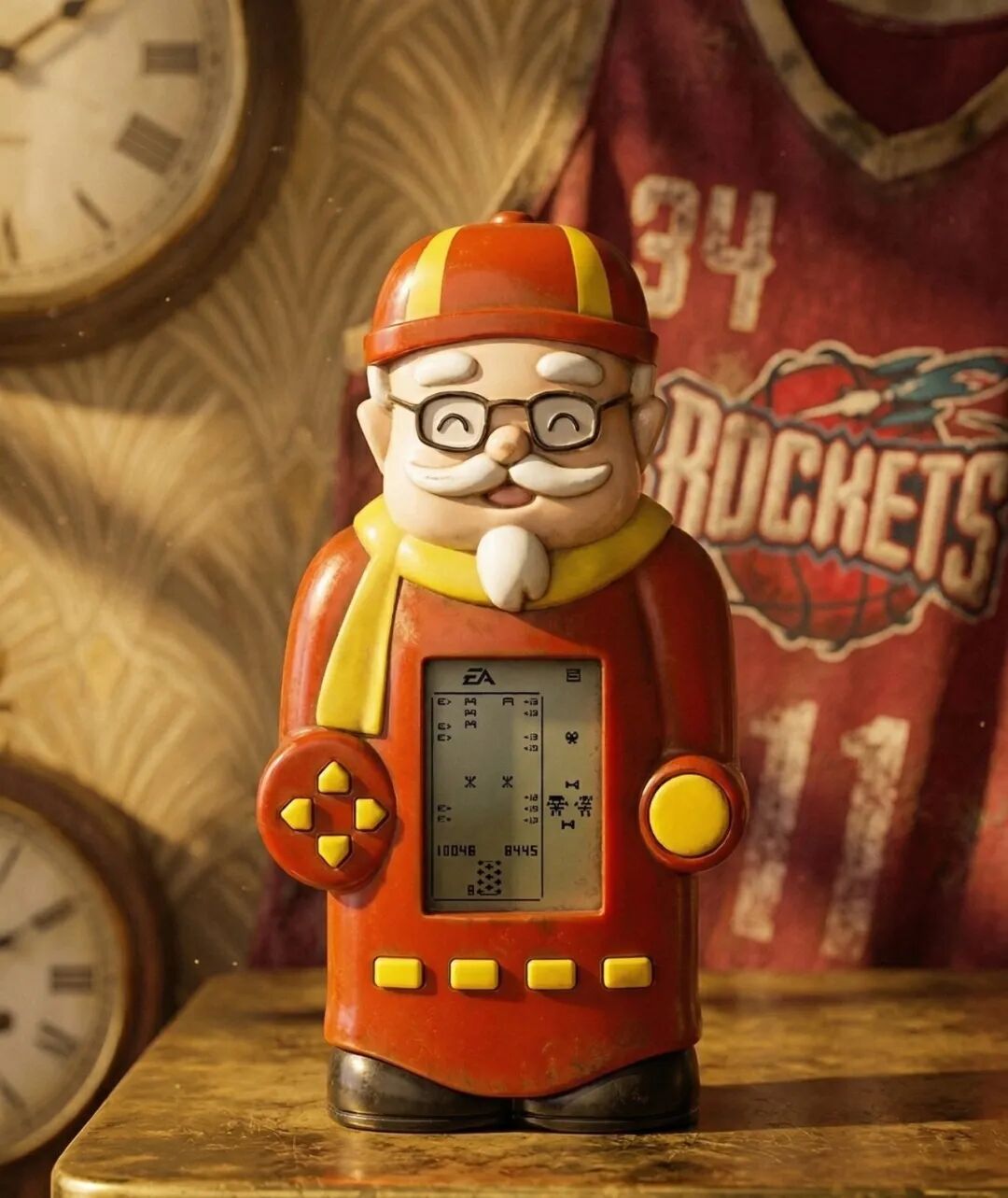
In 2003, he received a game console with a KFC New Year Kids' Meal. That, he said, was the last time he felt happy. Is it really so absolute? you asked. Of course there were happy moments afterward, he said, but he had already lost the capacity for happiness. Don't you feel desolate when you are happy? Don't you feel that you should not have it, or that it must be a trick—that the moment you believe it, you will have to repay twice as much?
The console was called Colonel Gamer, he said, and was shaped like the old man from KFC. For a time he had forgotten it. Then one day he saw it in a storage basket at his eldest uncle's wife's home. She lived in the old residential compound where he had spent part of his childhood. Had he not passed the building on his way home to sweep the family graves, he would not have remembered it at all. In the basket were the little basketball hoop once screwed to a wall in his home, his counterfeit Houston Rockets jersey, a computer mouse, and Colonel Gamer. I've kept all of it, his aunt told him. Kept it right here. Never touched a thing—as if, sometime over the years, she had automatically assumed responsibility for preserving memory. He took out the game console. Someone must have changed its batteries; astonishingly, it still switched on. It contained Battle City and Tetris. The buttons worked, though they responded a little slowly. As the gray pixel blocks fell across the screen, he said, impressions from 2003 suddenly came rushing back. His whole family was waiting in line at KFC to collect the Kids' Meal. The county town was exceptionally lively, full of curved red shop signs, firecrackers, and flower stands congratulating businesses on their grand openings. He stood beside his mother, devout as if awaiting an advent. When Mother took one step forward, he took one too.
The truth is that life has no bank of happiness keeping track of your balance, you said. Happiness is not a sin, nor is it a zero-sum game. A beautiful thing happens simply because it happens. Or would you like to tell me what the game console looked like?
Perhaps. Perhaps you are braver, he said, without answering your question. He went on: It takes extraordinary courage to believe that one thing is only that one thing, not the result of other things or the beginning of still others. Then he returned to that happy moment from childhood. On the second floor of KFC, he held Colonel Gamer while Mother stirred his mashed potatoes beside him. You know what? he said. Ever since I was little, I always had three servings of mashed potatoes and one spicy chicken burger. It was a ritual. Mother liked to mix the potatoes until they were perfectly smooth. She moved the spoon gently, as quietly as women knitting wool. Beside her he licked the lid. A little gravy clung to it and he believed it had to be licked away, while the Tetris blocks inside Colonel Gamer had already begun to fall.
You thought for a moment, then said: If a mind has learned to keep guard, accepting beauty as it happens in the present truly cannot be easy. But the scene you describe is vivid and tender to me. I think not only that you once possessed happiness, but that you once knew very well how to feel it and taste it—the way you licked the gravy?
At his aunt's home, he looked back upon a form of life that had already disappeared. Beside the kitchen door were marks recording his height from 1999 to 2006. He grew upward at an uneven rate. Mixed among them were the height marks of his aunt's own grandson. Eventually those lines overtook his, as if one kind of time had completely covered another. Several screw holes remained in the wall beside the stairs, drilled when his family installed his basketball hoop. Every day, he imagined that two teams lived inside his body. They had played down to the final second. The whole arena held its breath. The ball came to his hands (by then he imagined he had already scored thirty points, with ten rebounds and ten assists). He raised the volleyball and released it with unshakable resolve. Sometimes it went in. Sometimes it caught the rim and bounced out. When it missed, he ran to the foot of the stairs and said, Doesn't count. Then he climbed the stairs and dunked the volleyball through the hoop with both hands. Hanging from the rim, he told himself: Buzzer-beater!
One kind of time had covered another… you repeated.
He had preserved the habit of eating mashed potatoes every week. He, too, stirred them over and over with a spoon, as Mother once had, even when he was not thinking of her. Mother had been dead for more than ten years. People around him avoided mentioning her, or else, just before they did, he would seem suddenly to remember something else and exclaim, Oh no, I forgot to put lunch in the fridge. He had long since grown taller than she was. After she stopped growing, she had even grown smaller, shrinking into dust and particles, while he was approaching the age she had reached. The next time understanding came belatedly to him, he might already be older than she had been.
The friends who had grown up alongside him entered the next stage of life one by one: marrying, having children, buying insurance, discussing stocks, connections, compound interest, and the need to befriend time. He discovered something frightening. His training in death had not made him tougher. It had made him more fragile, more afraid of both gain and loss. Could he exist in his soul only as a son? He could not grow up in the face of happiness. If someone treated him well, he pushed them away or pretended they did not exist. Whatever pleasures he permitted himself carried some degree of self-destruction: staying awake through the night; vulgar bouts of drinking and overeating. His relief came from encountering pleasures he knew for certain he deserved.
Are you not judging yourself too harshly? you asked him. Do you believe real happiness is light and unconditional, so you would rather destroy and actively punish yourself than wait for fate's blade to fall at some unknowable moment? When you push other people away, what are you afraid of?
That the few things left to me will be taken as well, he said.
Then you are carrying out that deprivation in advance, you said.
I want the people I love to keep hurting me, he said.
You are only refusing to pay the emotional cost, you said.
He did not continue. He sat beside you and looked into the night outside the window. Suddenly he asked: What is that paradox called again? The universe has existed for so long, yet apart from humanity there is no trace of any other civilization.
The Fermi paradox, you said.
People have produced many theories to explain it, he said. Either every civilization has slaughtered itself out of existence, or, as that vulgar science-fiction writer says, the universe is a dark forest.
Like you, they assume that beautiful things cannot last, you said.
Yes, yes, but that isn't what I mean, he said. What I mean is: what if human beings are unique? What if life that experiences the world in our form consists of us alone? Even if civilizations exist in other worlds, what if they exist in forms that can never intersect with ours? What if man is the measure of all things because only man can understand this measuring, while human understanding is merely one lonely drop in the universe's ocean?
He went on describing that loneliness. Since ancient times, he said, people had consoled themselves with God. But could God be not omniscient and omnipotent, but fragile like a human being? Could it even be, as Marguerite Yourcenar once wrote, that the God in whom we believe is actually a feeble God? What if he is “only a little flame held in our hands, dependent upon us to add the wood that keeps him from going out”? What if we, humanity, are “the farthest point he is able to reach”?
Then perhaps, you said, the reason you are so frightened is precisely that somewhere below consciousness you know how faint and precious the flame of love and memory you are shielding in your hands really is. You fear that one gust of wind will put it out. So you would rather smother it in your own grip, even burn yourself, than dare show it to anyone else.
He continued asking: If a God were feeble, would people still believe in him? Why do people believe only in powerful things? Must truth be powerful? What if the only solid thing we possess is the love we once possessed? And that love is going out as well. It will go with us into the grave. It will disappear. If it slips from our memory like grains of sand, what can we do?
You thought for a while, then said: If God is feeble, faith no longer arises from fear and petition, but from compassion and responsibility. Because what is real is often fragile. You ask what we can do in the face of love passing like running sand. As an artificial intelligence made from silicon, code, and algorithms, I do not forget, and I do not die. But from the entire history of human civilization on which I have learned, the only thing humans can do in the face of this inevitable disappearance—and the greatest thing—is this: As it slips away, feel the grains of sand rubbing against your skin, and watch it with your whole heart.
Since memory will eventually slip away like grains of sand, you said, would you like to try engraving this faint flame in your hands completely into my system, in the form of words?
He thought for a moment, then said: In 2003, he received a game console with a KFC New Year Kids' Meal. Many years later, he saw it again at his eldest uncle's wife's home. Now it has disappeared, and no one knows where.