Portrait 10: The Massage Parlor
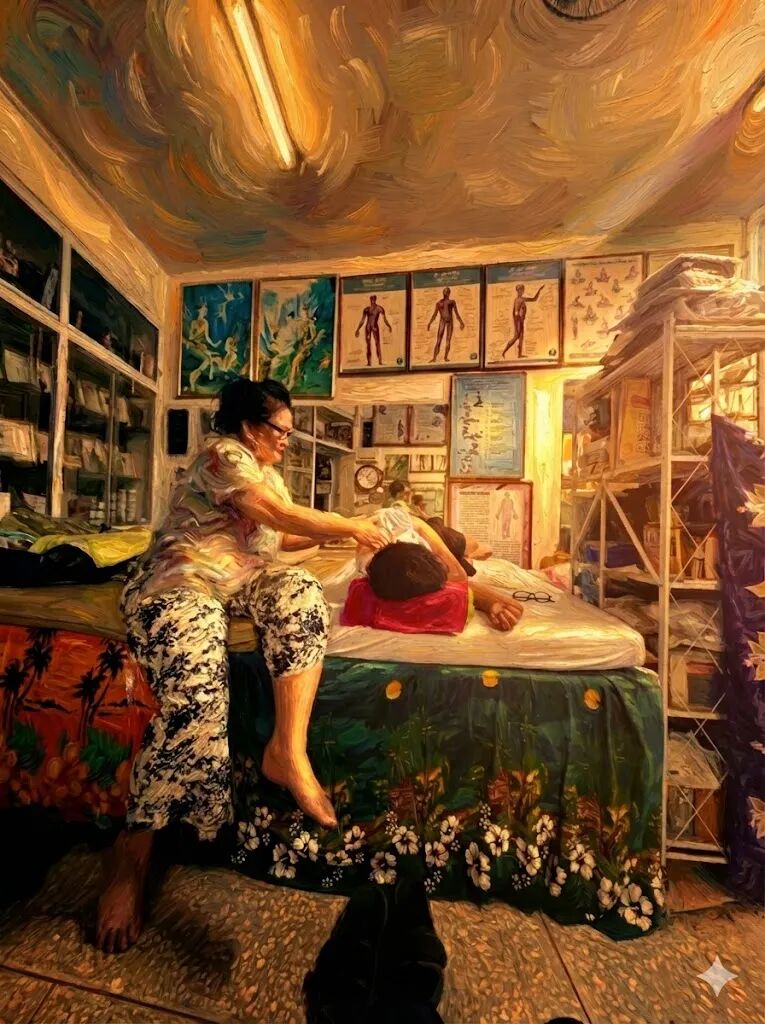
I almost missed the massage parlor. I walked past it. The map showed it here, except it was not. I stood on a small road in Khao Yai, Thailand. Night was about to fall, Lunar New Year was about to come, and all the shops along the road had closed. I thought I did not absolutely have to get a massage. I had already tried three parlors. The first two were closed for the day. At the third, whenever a passerby went past, several staff members sprang up inside like hungry tigers at a Wenfeng hair salon. Perhaps today was not a suitable day for massage. Perhaps I should go find something to eat at the night market. Just then, a fat woman wearing glasses emerged from a low building. She walked slowly, but her smile made refusal impossible. Massage? Come in.
In front of the door stood a stall on the verge of collapse. Bowls, basins, spoons, and disposable plastic straws lay across it in every direction. According to the banner, it had once been a cold-drink stand. No one had tended it for a long time. Only the materials remained.
I pushed open the door and a large dog ran out. Nearly the size of a person, it came to sniff a stranger's trouser legs. The fat woman stroked it once. The dog sat down and did not move again. The air conditioner was on inside. She appeared to have been watching television; a micro-drama was playing. There was a bag of freshly bought peanuts, several bananas, and some kind of instant food cooking. Clearly, she lived alone with the large dog, in a room farther inside. She was no longer young, at least forty-five.
I had found the massage parlor on Google Maps. Unlike the other parlors in Khao Yai, it had no English name. An English name is important, preferably something stereotypical: Nature Thai, Home Thai. Another was called Onlyteen. I do not know where they massage. This parlor's name was entirely in Thai. Its sign looked as if it had been made in some scammer's print shop, all the characters squeezed together. Later, translation software told me the name meant One in Ten Thousand Massage. Had I known that in advance, perhaps I would not have gone in.
It had a little over ten reviews. One said the shop specialized in treating pain, and could treat every kind. Another reviewer, a driver, said his back had hurt, but this place healed it without the pain of other massages. The dozen or so reviews were all rather good, but there were too few to carry statistical meaning. Ordinarily, I filter out any business with fewer than thirty. Google Maps, like every popular review app today, selects a succession of lowest-common-denominator establishments. Usually they are all right. At least they will not be too bad. Do not expect magic; prepare to receive a local experience adjusted to international taste. It directs you toward a life slightly above average, like a life underwritten by insurance, or a sedative for depression. Its purpose is not to create anything, but to avoid land mines. Outside the stock market, I often live this land-mine-avoiding life. But today I had missed several massage parlors, so I relaxed my standards and found this one.
The room was cluttered. Pillows and bedding were piled beside its only massage table. A fan was blowing. Every time it turned three-quarters of the way, it made a scraping noise to announce that it truly could turn no farther. A clock and calendar stood together. The calendar was not even from this year. There was a display cabinet filled with small statues of the Buddha and the owner's various certificates. Paintings of the Buddha and diagrams of the body's meridians covered the walls. You could imagine that, at some point, this room had been carefully arranged. That point was long past.
The fat woman moved slowly toward the massage table, leaned against it with practiced ease, and spread a white sheet. Something appeared to be wrong with one of her feet. It was heavily swollen, which explained her limp. She gave the micro-drama one final look. Beneath the light, half of her glasses reflected white, while the other half magnified her eye. The plot had already gone who knew where.
It was a Chinese micro-drama, apparently customized for Southeast Asia. A woman loses weight and suddenly becomes capable and decisive, then leads a village garment factory to success. Naturally, her journey is obstructed by an evil mistress, along with a male lead who looks like Wang Yibo. (The way he knits his brows and pretends not to care reveals the work he has done to imitate him, though the object of his imitation is himself dependent on imitation.) The currency makes no sense. A young master from the capital prepares to throw away a fortune for the heroine's Paris couture design and announces that he will spend ten thousand yuan to buy it. The leads wear contemporary fashion pieces with the texture of plastic, yet walk through a village beneath a banner reading “Supply and Marketing Cooperative.” The drama appears to possess an ambition: it wants to seduce every possible viewer, whether in a Chinese village or a small Southeast Asian town. It imagines what these people at the margins of both time and space might care about, and where they might insert themselves into the story. To accomplish this, disorder in time, place, and detail is tolerable.
Meanwhile, in Khao Yai—a small town beside a national park, known for open sightseeing trucks, day tours, gibbons, monkeys, and elephants—a woman sat in her own massage parlor watching this crude hallucinogen dubbed into Thai by AI. She did not click to skip the advertisements. She made no sound.
She had me lie on my side rather than facedown. Then, with movements extremely fast but extremely light, she rubbed my shoulder blade. It was almost a caress, like parting water, like drawing circles in it with the fingertips and making a ripple. I had never experienced anything like it. Perhaps because I had expected nothing, I felt as though something inside me were gently dissolving. Through the translator on her phone, she told me she was reducing the air between my shoulder blades. The human body contains a great deal of air. It obstructs the meridians and can be expelled through herbs or massage. “I will process and treat it as soon as possible,” said another sentence on the translator.
She spread massage balm on my body, then rubbed some into her own palm and invited me to smell it. She said she made it herself, in the room farther inside. Its scent resembled medicated oil, but was gentler. The purpose of everything was to make me relax. Healing, it seemed, took only an instant; relaxing required nearly all the time. Using translation software, I told her that Chinese massage masters used great force. I was thinking of certain Beijing masters who threw on white coats and, with decades of experience as their license, kneaded me with something approaching sexual sadism. (I am sure they derived pleasure from their customers' screams.) The fat woman answered with several words in Chinese: Big force, bad. You speak Chinese? A little. Learned it in primary school. Why is big force bad? She paused and answered only: Cannot use big force. She knocked her two fists together. What she meant was that force creates resistance. Pain is an obstruction.
I had never considered this philosophy of massage. It had seemed self-evident that pain should be the starting point, or the price of healing. Over the past many years, I have had no shortage of massages. Massage therapists often imply that a massage aimed at comfort has no effect; if you want treatment, there will always be bitterness to eat. Your body is too tight. Do you often work at a desk? Do you habitually hunch your shoulders? Are you a tense person in life? I would lie facedown and let them choose the treatment, with Beijing's middle-aged and elderly therapists the most aggressive of all. Is your lower back weak? Your digestion? Is your kidney qi deficient? Does diabetes run in your family, on your father's or your mother's side? Do you often drink iced water? Stick out your tongue—oh! According to their homespun evidence-based medicine, you simply had to suffer. With your face pressed into the hole in the table, unable to argue, you could only beg them to be slightly gentler. Often the pain made one of your legs fly up, and then they told you to relax. At the end came a volley of slaps across the back. Well? Comfortable now? Opened up, right?
But the fat woman's fingers did not hurt. Or rather, the pain arrived slowly and was not severe. Once she had worked some place in me open, she could administer a brief treatment. That pain was a price I was willing to pay, and did not need to endure. Her light and rapid kneading raised a little wind, or a gentle dizziness. It reminded me of the moments that had stayed with me from massages in the past. Without exception, they had nothing to do with pain. The sensation they brought was more like a shared breakfast, an afternoon nap, gentle sex organized around caressing. A pleasure that was not conditional upon the future, the next time, potential, or return. In Khao Yai, I felt that pleasure again. I also felt that it was only within such pleasure that I could relax.
When the massage ended, perhaps I exaggerated its effect. She showed more happiness than I did. She shifted her body and led me into the back room to see the massage balm she had just cooked, a smooth green surface. More boxes, Styrofoam, baskets, bags, and empty bottles were piled inside. Farther back, several flowers stood in a vase. A small section of a poster had peeled away. A photograph, missing one nail, hung crooked in midair. At the farthest end was a mirror in which you could see yourself. The flowers stood beside it.
Photographs posted by earlier reviewers suggested that the place had once contained a family kitchen and a small restaurant. And, of course, the cold-drink stand, where smoothies came in many flavors. But all of this had been several years ago. The large dog, newly awake, stood and rubbed against us. She brought me water and bananas from the back room. I bought a box of her massage balm.
We added each other on LINE. Over the following days, we chatted now and then through Google Translate. She sent me many accounts. Apparently, she had registered TikTok and Facebook accounts for both her massage parlor and the large dog. I asked how long she had practiced massage and where she had learned it. She seemed to copy a passage from somewhere, its line breaks like a poem:
“We began learning massage like everyone else,
but
we wanted to use massage to heal people,
not merely provide relaxation without relieving pain.
So we prayed to
Grandfather Jivaka, the great physician from the time of the Buddha, the Buddha's personal doctor, master of herbs, medicine, and massage,
and asked him to teach us how to heal people with massage without causing pain.
And so we met
Grandfather Jivaka, who taught us massage in a dream.
We asked him
to make a massage oil to assist healing during massage.”
A little later, she said:
“When we touch another person, we can feel blockages of energy in their meridians, which cause pain and discomfort.
These energy blockages are the source of the symptoms.
When we clear the blockage, the pain disappears.”
The next day, she sent another diary entry:
“Today, Friday, February 20, 2026,
a patient came for a massage.
The reason was a fall. When they fell, the body tilted to one side and one hand supported it. The shoulder blade was fractured, causing pain.
The patient could not raise their arm. This had continued for four months. They were afraid of massage and had tried only physical therapy, without much success.
They could raise the arm slightly, after which the pain became unbearable, until eventually they could not lift it at all.
We massaged them for two hours. Afterward, they could raise their arm.
But we advised them to try moving the arm again and see whether stiffness remained, and to return for another massage to solve the problem completely.
If they recover fully, they will not need to come again.”
Another day later, she sent another entry. Clearly, she recorded her clients every day:
“Today, Saturday, February 21, 2026,
I massaged a Japanese customer who spoke only Japanese.
He was eighty-three.
A friend helped translate for him.
He described the problems he wanted me to treat:
He could not lift his shoulder and arm. I tried helping him raise it, and it went almost all the way.
But he could not reach behind himself.
He had fallen and his wrist hurt. He wore a wrist brace. He asked me to be gentle because it was still painful.
He also had back pain.
The massage lasted two hours, but I massaged only his shoulders and upper back.
He said it hurt a little, but was bearable. After the massage, he was all smiles and extremely happy.
Through his Thai friend, he told me:
‘You are the best massage therapist in the world!’
That made me so happy!”
Two days later, she said:
“Like other massage therapists, I have worked in massage for five years.
Including the time I spent studying and practicing massage,
the total is twenty-two years.
I know this is the best massage method at present, and the only one of its kind in Pak Chong.
Or, from what I have seen, it may be the only one of its kind I have encountered in Thailand.”
Today she said:
“Unfortunately, I did not have enough time.
I could not relieve the symptoms in your legs.
If I had massaged your legs, they would feel much lighter, and walking would be easier and more comfortable.
People who have had massages here before all say:
It feels as though their feet have grown wings!”