Jazz 5: Snakehips Earl Tucker
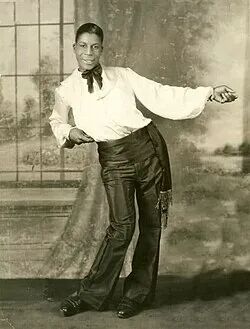
Earl Tucker, nicknamed Snakehips, was a celebrated dancer in the Harlem of the 1920s and 1930s. He had the long face of a bull and long, thick lips. With his hair pressed down by Vaseline, one could smell his temper from a distance. And indeed, in daylight he liked to toy with his folding knife, stroking the tip of its blade across his nose while his eyes slid about, suggesting dangerous things. But what people delighted most in discussing was the absence of all obstruction in his hips when he danced. Those hips twisted and revolved, creating curves from empty air, very much like the animals in our world that travel by winding. Some called him the Human Boa Constrictor. More called him Snakehips.
He died young, before he was thirty-one, and left only two fragments of film. The most famous comes from a short called Crazy House. Inside a futuristic room, its wallpaper covered in space and planets and bright balloons arranged in the corners, he appears like an unfamiliar creature. Dressed in shining clothes, he displays his impossible body to a beautiful tune whose name is now unknown.
Perhaps it is necessary to explain Crazy House. It is a none-too-funny absurdist comedy about a patient who visits a doctor because he suffers from double vision. Everything he sees becomes two, so he also spends twice as much money. The doctor offers a string of technical conjectures that amount to saying fuck-all. The patient then asks twice in succession: “Why is it that when I stand on top of a tall building and look down, I become dizzy?”
The short was made in 1930. This dialogue, together with the complaint at its end, represents a technological anxiety stretching back to the nineteenth century: technology makes people dizzy, whether it takes the form of medical terminology or a man-made high-rise. Later, the doctor leaves the patient with his assistant. From her mechanical little steps, the patient discovers that she, too, is a robot. Then he discovers that the whole building is populated by strange people. A musician smashes his own violin. A cook claims to have invented a plate that can never break. The patient tries to leave. At that moment the doctor reappears and says he wants to show him something, pointing toward the futuristic room. Earl Tucker is there, dancing.
One point rarely mentioned is that Earl Tucker appears in the film as a patient. After he finishes dancing, the doctor tells the protagonist: He suffered from the same illness as you. I cured him. Now I am going to cure you. The doctor then empties a hammer and screwdrivers from his bag onto the floor. This is, naturally, a satire of reductionist modern medicine, which treats people as parts and the mind as the integrated reflection of a physical world. But what draws me more is Earl Tucker's position within it. Here he seems to represent a deformed beauty. A beauty abnormal, alternative, twisted, dangerous, trembling, dizzying.
During the twenties and thirties, Tucker performed mainly at Connie's Inn and the Cotton Club. He also danced regularly at the Savoy Ballroom. For a time, his snakehips dance became a craze. In Prohibition nightclubs, white audiences trained their gaze on his waist as if watching a beast in a rainforest, waiting for some magic to happen on the next beat. Zora Neale Hurston observed: “Negro dancing is dynamic suggestion. No matter how violent it may appear to the beholder, every pose gives the impression that the dancer will do much more—more.”
Tucker was said to have drawn a gun to warn people who tried to learn his steps. Eventually, however, he made some compromises. One night he arrived late, and Connie's Inn sent a Black dancer who had just turned eighteen, Bessie Dudley, onto the stage as a last-minute substitute. Bessie reproduced the essence of Snakehips perfectly. Tucker burst into the club to find the whole audience roaring for the girl. He trembled. His little folding knife snapped open and shut in his hand. Backstage, he cornered Bessie and told her the stage was his. Every one of those steps, Snakehips included, belonged to him alone. Just as he was about to swing a fist, the manager told them: The audience loves you two. Starting tomorrow, you go on together.
By day, Tucker gambled. He was the kind who staked everything he had. At the card table, he crossed his legs so that the gleaming leather of one shoe almost grazed the tabletop. As long as he had money, he stayed in. When he lost it all, he would leap up in a sudden rage and flick open the folding knife in his pocket with a fingernail. One day he stabbed another gambler in the abdomen. Several years later he stabbed his performing partner Lavania, who stabbed him back. On many days he walked the streets of Harlem in the same overexcited state he carried onstage, shaking his body and occasionally shouting something aloud, expecting everyone to look up at him as they would a star. Around him, his fellow Black people worked as laundresses and servants, hauled cargo at the docks, or glanced left and right beside the revolving doors of hotels, waiting. He felt that daylight did not belong to him. Snakehips came out only at night. He, too, began comparing himself to a snake.
His appetite for sex was powerful. At the time, sexuality was encouraged as a distinguishing trait. Like Rasputin, he treated his unusual middle section as a natural gift. He believed he could do whatever he pleased. He believed everyone was obsessed with the motor in his belly. More than once, he was accused of coercing minors and of rape. Even Bessie once pressed charges against him for assault. Someone always bailed him out. People were waiting to watch him perform that night.
Every night there was a live band. The finest musician sat at the piano, watching Tucker turn his hips without tiring. This was Duke Ellington, newly contracted to perform at the Cotton Club, his future apparently brilliant. As he watched Tucker and played, however, he was thinking about something else. He wanted to write a composition that would vindicate jazz. It would tell the life of one Black person, and that life would contain the lives of all Black people: their humility, tenacity, optimism, and longing. The ambition almost crushed Duke Ellington.
In the end, that ambition became the 1935 Symphony in Black: A Rhapsody of Negro Life, a nine-minute musical film. The film is a jazz rhapsody in four movements. The first is the laborer: miners carry coal to the drums. The second is a triangle of dance, jealousy, and the blues. An eighteen-year-old Billie Holiday plays a betrayed woman, her lament moving through a muted trumpet. The third movement is a hymn of sorrow. Soft muted trombone and saxophone guide the camera toward a quiet church, slowly approaching a minister. Then we see people praying, people waiting. In the fourth movement, “Harlem Rhythm,” trumpet and clarinet begin to move again. Here Earl Tucker enters.
He is not the sole protagonist, nor does he display the astonishing Snakehips of Crazy House. Together with a line of jungle dancers, he appears as a reflection on the screen, more a symbol of rhythm than a person. And that rhythm points toward a vain, intoxicated life of luxury. People raise and empty their glasses while Tucker turns and shakes, as if he were a modern footnote. Was this how Duke Ellington felt when he watched him dance several years earlier? Was Tucker happy to represent such a life?
Two years later, Earl Tucker was dead, not yet thirty-one. Newspapers said a mysterious illness had killed him. Some said syphilis, some an overdose, others that he had been stabbed to death. For a hoodlum like him, none of these deaths would have seemed strange. Only after he died did people remember that he had long been married, with a wife and a ten-year-old child. He disappeared from the casino. The gambler he had stabbed in the belly still saw him in nightmares. He disappeared from the nightclubs, where younger Black performers had already taken the stage. Then the war began. No one mentioned his name again.
But the way he invented of using the hips survived. Elvis used it. Michael Jackson used it. Neither had the chance to see Earl Tucker perform those movements in person. People often say that a dance step reaches its fullest expression in the body of its pioneer, not its imitators.
Was Earl Tucker, then, that pioneer? In a remembrance of Tucker, the New York Times writer Brian Seibert excavated a possibility. He cited Duke Ellington's recollection that Earl Tucker came from Maryland's tidewater country, where people still retained “pagan customs and religious convulsions.” Seibert went further: “Tucker's body shaking most likely derived from dances depicting ‘spirit possession,’ dances long incorporated into Pentecostal, Holiness and Sanctified religious traditions.”
In other words, Tucker may have developed his style from watching Christians in his childhood community close their eyes, fling up their limbs or convulse, loudly proclaiming themselves possessed by God. A movement that displayed ecstasy within purity somehow evolved into a symbol of lust. Or perhaps the two were never so clearly divided. Snakehips survived and became an important element of popular culture. A hundred years later, our civilization has inherited the same contrast: extreme conservatism and extreme pornography mingling, spiraling upward inside the same human body.
I have always felt that the ecstatic convulsion of religion is a bridge between hallucination and reality. In that moment, whatever a person wants to see, he can see. Earl Tucker secularized the convulsion and turned it into a technique of the body. Over the past hundred years, more people have taken another road, refining the same convulsion into a technique of the mind. The latter is always more dangerous, more violent.
Many might say there will never be another Earl Tucker, that his style was unique. But recently I saw a video of a vulgar talent competition, everyone saying the correct bullshit, the host in particular: “Whether he sings well or not, whether he dances well or not, we should all affirm him, okay…” Only the short contestant kept dancing to himself. His dancing was not beautiful. It could fairly be called ridiculous. But he reminded me of Earl Tucker. I kept wondering what made that style so powerful. Self-forgetting? Confidence? Resolve? Now I know. It was fearlessness.