Jazz 4: Traveling to Dance
Turkey
Because of dance, I have traveled abroad more often in the past two years. I go somewhere, attend its socials and weekend festivals, then wander its streets. Dance gave travel an anchor, as if it were a serious purpose in itself, as if dance left me no choice but to travel. In my twenties, before I had that anchor, I would often take leave—or use a business trip as an excuse—and rent a short-stay apartment in some small city I had never heard of. Those rentals were often meant for affairs. They contained chairs in strange shapes, pink furry whips suspended from the ceiling. For the first few days I would stay inside, as though the trip had not yet begun: looking at my phone, sleeping, or sniffing the whips and imagining what had happened there. At noon I would go downstairs, find a cheap little place, ask what the dishes cost and what the owner’s life was like, swallow oil and meat of uncertain provenance, then go back upstairs and get diarrhea. Why can’t a journey begin at once? Why do so many trips feel as though no traveling took place at all? Fortunately, those days are over. I learned to dance. Now travel has an anchor.
At the beginning of 2024, I went to Istanbul for the first time, for Jumpin’ at Istanbul. I had been learning swing for only a year and worried that I would dance badly and become a burden to my partner, so I learned a few compliments in Turkish in advance. “You dance so well!” At the social, after every song, I would say this to the girl across from me. They always burst out laughing. It was not until one girl asked why I kept complimenting my own dancing that I realized I had got the personal ending wrong: I was saying ediyorum instead of ediyorsun. The event was magnificent. Masters from all over Europe had come; there were too many of them to fit on the stage. It was as though Istanbul had become the center of the world again. At night we returned to a shared apartment, every bed and sofa packed with bodies. Someone said swing dance was a gathering of proletarians from across the world.
By day, I wandered the city. I visited the Museum of Innocence, which Pamuk built for his novel of the same name. It is filled with small Turkish objects from the 1970s: toys, photographs, women’s accessories. I remember a man carrying a violin, studying each display case against the details in the book. I had not finished the novel then. At the end of the museum, I came upon the protagonist’s attic bedroom: his narrow bed, bicycle, lamp, picture frame, a half-finished bottle of rum. I was deeply moved by its plain reality. I did not know the museum was invented, that the novel was invented. So what?
Outside, I passed a secondhand shop and found some old photographs, probably taken between the 1950s and the 1970s. The bearded proprietor, wearing glasses, stood beside a globe and told me he had picked them up at flea markets and inside used books. Someone had sold a family album. Someone had used a photograph as a bookmark. They had come together piecemeal like that. He liked collecting things.
They were all keepsakes or fragments of ordinary life. In one, two girls in black dresses that looked almost like nuns’ habits stood before a stone building. One rested both hands on the other’s shoulders, displaying their friendship. On the back of the yellowed print, someone had written neatly in fountain pen: “Kız Lisesi” (girls’ high school) and “Ebedi hatırası” (eternal remembrance), dated 1953. Another was taken in a bar. A balding middle-aged man in a suit knelt on one knee and looked toward the sky; behind him stood a delighted woman and an exhausted-looking band. They seemed to be performing some family ritual, or dancing a comic dance. There were photographs of family gatherings, too: enormous Turkish clans filling a long table, a man resembling a mob boss seated at the very center.
These things moved me deeply. Not only because Istanbul is no longer like this, because Atatürk’s legacy, altered and misread, has been used to reverse secular reform entirely—or perhaps the country always leaned the other way, and Atatürk had merely forced a brief spectacle into being. Not only that. When I touched those photographs and bought some of them, I felt that memory had weight. Like dancing, they widened my life. Many things prolong and sustain life. Very few things widen it. They are rare.
Vietnam
During the 2024 Spring Festival, B and I went to Vietnam. In Hanoi, we found a local swing group that danced in the street every Sunday. We circled Hoàn Kiếm Lake several times before spotting them beneath the statue of a great man behind a post office. A girl held up a small speaker while several people danced beside her. Downtown Hanoi was so noisy, she explained, that if she put the speaker on the ground, no one could hear it. And so I joined them. The virtue of dancing is that it is already a form of connection. Jazz is your language; as you move closer to that language, you trust one another.
Afterward, we followed the crowd to a roadside stall for sweet soup. A boy said Hanoi had once had no swing dancing. Five years earlier, a Sri Lankan traveler had stayed in the city and taught him a few swing steps; he then taught the people around him, and little by little a swing community came into being. In fact, China had a similar story. In the years when globalization was still a beautiful wish, a traveling dancer taught the steps to local friends, who taught their own friends in turn. Culture was then regarded as common human property. People did not yet speak so readily of culture wars, capital, identity, appropriation. Another boy said he was a Marxist and was organizing Vietnamese university students in support of Palestine: From the River to the Sea. What, he asked, did Chinese Marxists think?
B and I went on to Da Nang. One night we found a row of loungers on the beach and lay down. We had just taken turns having diarrhea and were arguing about which dish at the market had broken us, rather than what we would do with the sea wind blowing straight into our faces. Still, the loungers were comfortable. We agreed that the people staying at the Hilton or the Marriott were not having a better experience than ours. In the end we were facing the same sea, while our public beach was broader and deserted at night. More importantly, it was free. Then an older woman walked toward us.
“Pay you,” she said.
“Pay us what?”
“70k one person,” she said.
We took out our phones to convert the amount. It was about twenty yuan. We looked at each other and made the difficult decision. B pried several Vietnamese bills from his painfully tight wallet and assembled 140,000 dong for her; because the wallet was so tight, a few low-denomination Chinese notes came out with them. The woman planted her hands on her hips, took the money, and walked off wearing the expression of someone to whom we still owed something. When she was far enough away that I was sure she could no longer hear, I shouted, “Fuck, she ripped us off.” B shouted too: “Fuck, what was that expression?” I added, “She’s just some old woman. What the fuck is she acting tough for?” B said, “That bitch has obviously lost at life. She’s dumping every misery in her family on us.” I said, “Her husband and son are definitely useless. Consider that twenty yuan a gift from your big brother.” B said, “All she knows is how to rip off foreigners.” I said, “Fuck it, I’m sleeping here till tomorrow morning. Let’s see how badly you’ve cheated us then.”
After that, neither of us spoke. We lay on the beach chairs. The Vietnamese sky was stickier than Beijing’s; even by the sea there were few stars, though the waves were gentle. We were both nearly thirty then, but not quite. I asked him, “Did you ever imagine this was what we’d be like at thirty?”
“Why do you say that?”
Go back ten years and we were roommates in America, discussing schools of thought and envisioning where the future might lead, as though our ideas would eventually claim their place. We thought the future would be turbulent, exciting, open to our participation, and that all we had to do was choose a field in which to make an impact.
“I definitely never imagined I’d spend so long cursing someone over twenty yuan,” I said. Then I added, “Still, this is not bad. I think we are generally honest with ourselves.”
France
This trip took place at the end of April 2024. By then I had left a job where I had to clock in with my fingerprint morning and evening, and started a small company of my own. One advantage of owning this sort of company is that you can keep its official seal in your drawer. Whenever you need a visa, your left hand can hold the supporting documents while your right hand stamps them. In May, a crowd of dancing friends and I arrived on the outskirts of Montpellier, where Savoy Cup, one of swing dance’s premier competitions, is held every year.
We rented an Airbnb. The host said it was large enough for six. I asked whether ten would be all right. She must later have turned the place upside down and extracted ten sleepable surfaces for us. I was the only cook among the ten. Early in the morning, I went to the farmers’ market and said, in the broken French I had stopped studying ten years earlier, “S’il vous plaît…” The vendor replied in broken English, “You want…?” In the end, we completed the conversation by pointing back and forth through the display case. Apart from the farmers’ market, I remember, it was almost impossible to buy fresh vegetables nearby. There were all kinds of frozen, semi-prepared foods, though their quality was decent. While the other nine were still snoring, I would already be cooking. The apartment had no range hood, so all our clothes acquired the same smell.
Savoy Cup was the dullest event I have ever attended. Looking back, I think that when an event revolves entirely around competition, the most precious thing in swing is lost. Savoy Cup aspired to be the highest temple of swing technique. Every sort of contest ran in succession each day, and the level was indeed formidable. But the arrangement of all that competition exhausted me. Even with my limited experience then, I could feel that the dancers were not happy—or were pretending to be. One of the few scenes that stayed with me was the Korean dancer Suhee. She had broken her leg before coming, so in Duo Jazz she held up a crutch and used it as her other leg. Through the rhythm and vitality of her body, she and her partner advanced all the way to the semifinals. I had seen her in Istanbul, and spoke to her this time at a social. She said she had danced for only two years, but had quit her job to study in Brussels and train full-time.
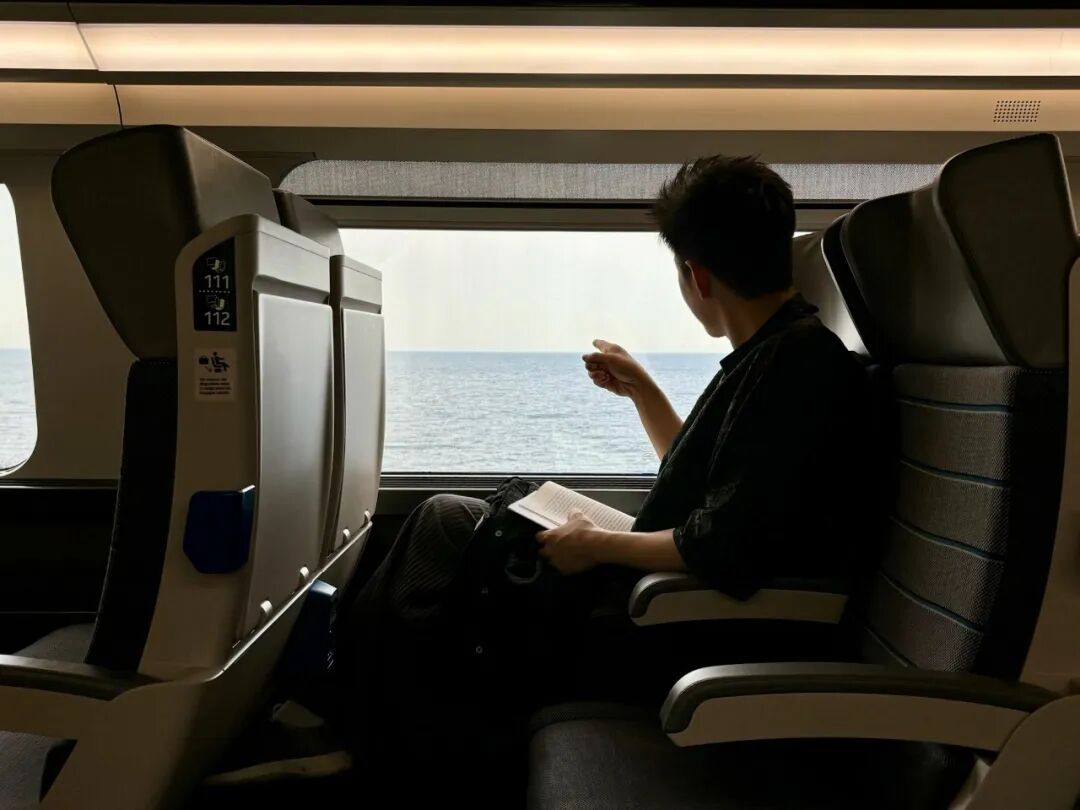
After Savoy Cup, we traveled through southern France. In Antibes, the train would suddenly pass a great expanse of blue sea, as though we ourselves were gulls. Later I went to Amsterdam and Paris. Once, between trains, I visited Paris’s paleontology museum. The skeletons of enormous animals gathered there like teeth suspended in the air. I walked past them one by one, lost track of time, and missed my train. I thought of a scene in La Jetée, in which the man travels into the past and meets his new lover in a museum like this. I can still remember the narration: “On about the fiftieth day, they meet in a museum filled with ageless animals…” Once animals have been made into specimens, they lose their age, like people moving through time and memory. I had always assumed that scene was filmed in this museum.
Sweden
I had never been to the Nordic countries. To me, they seemed unreal in their goodness. Can you imagine a welfare state without hypocrisy, where people are neither greedy nor blind, where they assume goodwill in one another, treat both their own children and other people’s well, and where rights protect human dignity? To me, beauty like that floated in the air. Or rather, the beauty I linger over has always required evil as its contrast. Yet in the world of swing, Sweden is a place one must visit. And so, though I was terribly busy that July, I forced myself to go. It is home to the largest dance camp in the world: Herräng Dance Camp.
Swing dance emerged in New York’s Harlem in the early twentieth century. Black dancers moved to big-band jazz and made something radically new: wild, comic, driven by improvisation and rhythm. For two hundred years before that, enslaved people in cotton fields, forbidden to speak, had secretly tapped out rhythms passed down from their West African ancestors. At night they went to Black barns, where they embraced, sang, and danced. After the Second World War, the big bands dissolved, rock and roll rose, and swing dance was nearly lost. Then, in the 1980s, some young people rediscovered this culture. Among them were several Swedish punks, who found old footage of swing dancing in a basement archive of the Stockholm library. What was this? Why was its comedy so beautiful, so unrestrained, so powerful?
The camp at Herräng has run for more than forty years. Beside an abandoned mine by the sea, using the grounds of an old elementary school, it raises one enormous tent after another each summer. Dancers from around the world take classes inside and dance through the night. For decades it was led by Lennart, one of those young Swedish outsiders. At first they invited aging legends such as Al Minns and Frankie to teach. Then the legends died and they took over themselves. Now they, too, have grown old. In recent years, controversy has followed Herräng: one group comes in, another leaves, Lennart among them. In his unsparing retirement letter, he wrote that old meanings of courtesy, consideration, and style had been lost.
In July, Sweden has almost no night. The sky barely darkens at midnight and is bright again by two or three. The dancers, accordingly, danced until dawn each day, returned to the dormitory for a few hours of sleep, then got up for class. At noon, unless you cooked for yourself, you had to eat in the expensive cafeteria, where much of the food tasted worse than something frozen spun in a microwave. So I borrowed the dorm’s communal kitchen and became a cook again. My diners grew from one person to two, then to a crowd. On the last day, hot oil splashed my arm and made it bloom. The doctor examined the raw skin, told me to leave the wound exposed and stop dancing. I could not bear the thought, so I returned to the floor and danced another entire night. By day, we sometimes rode bicycles to the sea. It rained often. The road was so dense with snails and black slugs that not killing anything was difficult. The water was bitterly cold. I went in once and never wanted to go in again. Islands lay in the distance. The whole of northern Europe seemed stitched together by islands, marshes, and sea.
The virtue of Herräng is that the world’s finest dancers come to teach and, incidentally, take a holiday. It is easier to find them for a dance there than at an ordinary event. By then I had begun learning solo jazz as well as partner dance. My coordination was so poor that it became a personal style; some people even thought I was doing it deliberately. I met many good teachers that summer. Daniel Larsson stayed with me. I noticed that he sometimes placed syncopations and hard accents in the calmest passages of the music. I asked: aren’t we supposed to follow the music when we dance? Why are you moving against it? Music is not a compulsion, he said, but a space. What matters is not what it says, but what you do within it. You have to learn to lead the music yourself.
After my week at Herräng, I went farther north to Luleå, where another Daniel had started a summer camp of his own. Daniel Heedman, once a central organizer at Herräng, had also left after Lennart’s departure. Some people said the way he imitated Black Harlem dancers was unsettling, since he himself was blond and blue-eyed, almost a model of pure Aryan stock. Others said he came from a family of hunters above the Arctic Circle: ferocious in appearance, but guileless and incapable of political games. At his own camp, his difficulty was visible. He had invited the earliest generation of Swedish dancers, including Lennart and his partner W. They had all come to support Daniel, who was still young. At every class, W placed a photograph of old Frankie on the windowsill. When Frankie was alive and she was still a girl, they had taught together. Frankie loved to travel, she said. After he died, she carried his photograph everywhere so that he could see how far his dance had traveled.
On the final day in Luleå, Lennart collected questions that dancers had written on scraps of paper and put them to Daniel. At first everyone laughed and talked. Then came the last question: why had he left Herräng? Daniel stood up immediately, went to the door, and began to cry. His wife, Åsa, cried in her seat. “We still can’t talk about what happened,” she said through her tears. “But it was filthy. Filthy.” W went over and held her. Lennart sat on the windowsill, swinging his legs. For him, all of it was already in the past.
During the last few days of the trip, an enormous backlog of work had accumulated untouched, but I continued roaming the Nordic countries with a lingering unease. At the Nordic Museum in Stockholm, I examined the everyday objects Swedes had left behind in the last century, one by one: wooden horses with painted eyes, Mickey Mouse dolls with frightening smiles, shoes polished to a shine, shirts and top hats neatly folded, bras and stockings, all the tins they were so fond of. They, too, had listened to English-language radio and dressed properly each morning for work at the factory. Only there did I feel close to Sweden. Stockholm’s sea, ancient ship, and meatballs had all seemed too remote.
I spent several days in Helsinki, a civilized and boring city. The highlight was a day trip across the water to Tallinn, Estonia. Behind Tallinn’s railway station stood a flea market filled with wooden clocks, briefcases, cassette tapes, coins, and warped, yellowing postcards. The proprietor was short and bald. Postcards cost between fifty cents and one euro, he explained: the clean ones one euro, the dirty ones fifty cents. “So, my friend, what are you looking for?”
“Some photographs.”
“Photographs?”
“Yes. I collect old photographs.”
“Ah, photographs. The photographs are here. Old photographs, one or two euros each. What kind do you want? Army? Ships? Congresses?”
“No. Just ordinary ones.”
“Ha! I have the highest-quality photographs. Those family pictures, you know—heaps and heaps of garbage.” He mimed throwing something away. “I don’t sell those.”
“But do you have any?”
He slapped his forehead. “Ha! The Soviet era! Now everyone wants memories of the Soviet era. I have them. I have plenty. Look, a stack here, another stack there…”
He brought out two plastic bags, photographs of different sizes lying every which way inside. Most were family snapshots from the 1980s, some still inscribed and dated on the back. Many faces appeared again and again. Together, the pictures recorded the important days of their lives. A boy steered a ship. In another, he hauled in its mooring line. In a third, he stood stiffly beside his young cousin.
“Do you know the people in these? This boy on the ship?”
“I know him, I know him. He worked on a ship. What is the word in English… sailor. Yes, a sailor. He died years ago, around 2017. One boy, three girls in his family. A good man. Here, since you like these, I’ll give you another. This is my ex-wife’s grandmother. They are picnicking in the woods outside town. She is the one standing with a plate. This woman died last year. You can have it. Ten euros altogether. Oh, no cards. Cash only. The ATM is downstairs.”
Thailand
During the 2025 Spring Festival, J and I went to Bangkok. I discovered that I did not like the city: its stickiness, its kitsch, its self-Orientalism. Yet it drew me back again and again. Perhaps its food is delicious and its massages comfortable, and those two things alone are enough. Today I happened to read Alan Macfarlane saying that Chinese people are organized around food. That rings true. I feel closest to life, most wholly attentive, when my hand is gripping a wok and the flame is turned all the way up. Thai cooking gathers sourness, heat, salt, and sweetness into a single compound taste. Put simply, it wants everything. Cultures like that often have trouble seeing themselves clearly.
We danced in Bangkok, too. The Hop, a swing club in Chinatown, had just refinished its floor, and every step slid. As in Vietnam, most Thai dancers were very young. The difference was that foreigners made up a larger share, including more than a few older white men who were plainly hunting for prey. One relatively kind Italian gentleman was chatting with us and said he knew a certain master. He opened Instagram to find him, but his hand slipped and the feed went sailing downward: one large-breasted woman after another, while the phone somehow refused to close.
For several days we stayed in the countryside outside Bangkok, near the old capital of Ayutthaya. Our host was a retired civil servant nicknamed Papa. He went barefoot and dreaded any mention of money; whenever payment came up, he waved it away. No need. During the day, he drove us around Ayutthaya. What remains there in greatest numbers are stupas. It is said that when the Burmese burned the city more than two centuries ago, there were hundreds of temples. Did the torchbearers hesitate? How does a person persuade himself to set fire above another person’s Buddha? Today the ruins contain row upon row of headless statues. The victors must have cut off each head in turn to see whether gold or treasure had been hidden inside.
Later, people built larger Buddhas. Resplendent golden Buddhas. As we approached one, Papa dropped to his knees, raised his hands high, and closed his eyes.
United Kingdom
By the time I left the country again, it was summer. I had a month and a half abroad. B had moved to London for work, and I stayed in his small flat in the Barbican, sleeping on the other side of his bed. Sometimes he turned over in the middle of the night and threw one enormous leg across me, and then I could not sleep again. I once heard that one measure of a person’s success is whether, on arriving in a city, he stays in a hotel or at a friend’s place.
I had not returned to Britain for seven years. I realized that I had never properly lived there. Even before graduating, I had been desperate to leave. I hated its rigid classes, the intellectual calcification of its universities, the distance between people. But now I wondered: had I left because I hated it, or because I knew that elsewhere I occupied a position of natural advantage, where privilege would come more easily? This time I tried to live properly in London. I found that I still could not like it. To enter a garden, you practically had to open seven locks. Many canonical West End productions felt no closer to me than errenzhuan.
Fortunately, London had Skye Humphries, one of the greatest swing dancers alive. Every week he taught solo jazz in Highgate, in a room shaped like a small chapel, and I took the stinking Northern line all the way there. He charged ten pounds a class, roughly enough to buy a hamburger in London. Masters like him often teach very cheaply in their own cities, perhaps to give back to the community and uphold the principle that swing should be available to rich and poor alike. Yet such selflessness also constrains the livelihood of dance teachers more broadly. In Skye’s class, it was a pleasure simply to hear him hum a rhythm or watch him clap. Seeing that I was new, he came over especially to welcome me and make sure I did not feel like an outsider. He probably did not know that I had watched every video of him I could find from 2000 onward—more than once.
One day I returned to Cambridge. Again I wondered whether I had not thought of coming back to Britain all these years precisely because I did not want to return here. Except when applying for jobs or negotiating business—I was never ashamed to exploit the dividend then: You know, President X, I received rigorous training at Cambridge—I wanted neither an association with the place nor to become the sort of person it meant to produce. The thought of posing in a gown inside a college, or kneeling on one knee to receive my diploma from an elder—I did not even attend—made me sick. But my relationship with my supervisor, S, really was like that: a spiritual relation between master and slave. Perhaps one day I will sit down and properly remember our past, but not today. In any case, I met her again in Cambridge. She maintained the busyness of her pre-retirement life and spoke at astonishing speed. She recalled my dissertation and said it had been rather good. Really? I did not think so. Then she began praising the Cambridge system, unlike the Americans, forever switching subjects and directions. I asked whether she truly believed a person of seventeen or eighteen could know what they wanted, what they wanted to study. If you are coming to Cambridge, she said, you must possess that degree of psychological maturity. At last she brought the meeting expertly to a close and showed me out. I checked the time: thirty minutes exactly. As ever.
That weekend, B and I went hiking in the Lake District. The weather was poor. The rain grew heavier and we lost our way in a valley. We kept going, crossing streams, weeds, and muddy tracks, discussing as we walked what kind of life is a good life. In the middle of the conversation, the valley suddenly opened. Before us spread vast pasture, mountains, wind, and cloud, with a narrow road leading toward the edge of the sky. B took out a little speaker and played “Ride of the Valkyries.” We spun in circles toward what lay ahead.
Sweden
What kind of life is good, what kind is right, what kind is worth living? For me, this has always been the most important question. I often take inspiration from negation: a life spent obeying orders is not a good life; a life consumed by comparison is a terrible one. But where is the good direction? How I admire Plato, declaring the four virtues with such confidence: courage, wisdom, temperance, justice. Is it so simple? If it is, where on the spectrum do the days of indulgence, infatuation, and temptation belong? I love the ending of Bao Huiyi’s Chronicle of the Emerald Isle: “I am enchanted by the fissures between worlds. Though dark, moonlight enters every pore; fall there, and one no longer calls for help.”
A year after leaving Britain, I came to Herräng again. This time, J and I rented a wooden cabin with two bunk beds, one for each of us. It had a small stove, and I had brought hotpot base and cookware, so we did not eat a single meal in that rip-off cafeteria. We had not enrolled in classes this time. We were past the phase of taking them frantically. In fact, I had not realized how long I had devoted to this dance, how much time and money I had spent. Of course, the friendship, health, and happiness it gave me were beyond measure.
With energy to spare, we went to lectures and performances every day. That week included the Swing Kids summer camp. Dozens of children, from a few years old to their teens, formed a train and filed into the tent to dance. Would this dance leave a trace in their lives? When they were trapped, bored, or emptied of drive in the future, would they remember the music and steps that once brought them simple joy? I remember several nights when I was dancing toward dawn and anxiety suddenly arrived. Was all of this a machine for making dreams? Was it false? Was it sugar coating over the core of life? Was I truly creating something, or performing the appearance of creation?
Another great advantage of Herräng is the ease and low cost of booking private lessons with the best teachers. I remember J and I arriving for a lesson with Christian Frommelt carrying a long list of things we wanted to learn. He watched me dance, then spent the whole hour teaching me how to take the most basic rock step. Your entire lead is too tense, he said. You want your partner to travel from A to B, but you do not need to guide her through every inch. You need to leave space for both of you, then complete it yourself. These teachers seem to be talking about dance, but everything they say is about life. Another teacher, Pamela, did not even need to watch me. “I danced with you at the social last night,” she said. “There are too many stops in your dancing, and sometimes I don’t know what to do. Don’t be afraid of repetition. Trust repetition. New inspiration will slowly form inside it.”
After Herräng, we returned to Stockholm and stayed two nights in Lennart’s small apartment. Curiously, J and Lennart, W and I, had each built precious friendships by email, as though we had traded dance partners. What we did not know was that Lennart had moved to a city farther away. That day he spent hours on the train simply to see us. W came too. She was plainly exhausted, but possessed a warm, gentle strength. She continually returned the center of the conversation to the other person, offering sincere curiosity and attention. That quality in her character had not changed at all from the tender, spirited style of dancing she radiated as a teenage girl decades earlier. Over dinner, Lennart spoke about education and politics in Sweden today; his disillusionment was comprehensive. In the past, he said, we did not lock our doors. There were no thieves. Schools were strict, but children learned integrity and respect. Everything is different now. Sweden has become a gang state. The best age, he went on, must have been the 1950s—but that was before I was born. I lived through good times too. I simply did not know it then.
After dinner we walked through Stockholm together. “This is a cemetery,” Lennart said. “Look—the woman beneath this gravestone was once a hugely popular singer in Sweden. She disappeared completely late in life. Actually, I like living beside a cemetery. It is quiet here.” We continued. “Guess what is behind this door,” he said. “You have to take some pictures here. This used to be a boxing club. It is where we first began practicing swing in the eighties. We invited Al Minns to teach us in this basement, while next door the junkies and alcoholics crashed and clattered.” We climbed a hill. He and W stood with hands on hips, looking across at the island opposite. “I hardly think about dancing anymore,” he said.
The Baltic
I spent my birthday on a ferry across the Baltic, traveling from Stockholm to Tallinn. In Tallinn, I ordered a small pudding as a birthday cake. That year, the anxiety of achievement seemed stronger. By every measure, I had failed to meet my own expectations. Even my relationship with words had grown intensely strained. I seemed to have lost the ability to write lightly, gladly. My dancing, on the other hand, had improved a great deal. Perhaps we are better able to practice continuous, minute improvement in fields where our ambitions are small. Ambition truly can make a person perverse, violent, unable to breathe.
I took J back to the Tallinn junk shop I had visited in 2024. The short, bald proprietor was still there. He seemed more irritable than before, still advancing the endless agenda of his divorce over the phone. I told him I had been there at roughly the same time the year before. He leaned close, with eyes that clearly did not recognize me, and said with false enthusiasm, “I remember you! You bought coins and badges from me.”
“I didn’t. I bought photographs.”
“Photographs! I have endless photographs. One euro each.”
He ran out and returned with several huge plastic bags.
While J went through them, I wandered around the small shop. Records, old books, posters, and pendulums had been thrown together with considerable roughness, as though every object were urgently competing for attention. Had they once been treated kindly in their owners’ homes? When a memory once held solemnly is recombined, priced, and scattered into other people’s hands, how much weight does it retain? Returning here, I felt only disgust and weariness. Did this mean that I, too, was merely a prospector mining memory—interested in the sensation of novelty, contemptuous of the value and respect it once possessed? J bought some photographs. The proprietor repeated his old trick, pulling a random magazine from beneath the table. “You can have this too.” When the magazine opened, a cockroach shot out.
From Tallinn in Estonia, we took a bus to Riga in Latvia. The entire city center still bears the Art Nouveau style of the late nineteenth century. More than a century ago, it represented youth, imagination rising. Today, people can no longer identify what it is. The façades of Eisenstein’s buildings are covered in sculptures of screaming, distorted faces. By our habits, they could hardly be considered auspicious. At dusk, I found Isaiah Berlin’s childhood home. He was born here. His sweetest memories were here. Had he, too, watched half the sun sink past the corner of a building, gold climbing the ferocious faces of pharaohs on the façade?
One day we visited Sigulda, a neighboring town. I had heard that St. Petersburg was a city completed in heaven, which Peter the Great set down on earth as though assembling a toy. Sigulda gave me that feeling. Not far from the railway station, we discovered a river valley, forest, and cliffs beneath our feet: the town had been built on the heights of a gorge. Our guide, a tall local man, knew almost nothing of the area’s history or culture. What was the origin of that castle in the distance? Perhaps the Poles built it, or perhaps the Germans. What was the history of Sigulda? The Poles had come. So had the Russians.
We descended into the gorge through this dialogue of questions without answers. Gradually, however, I discovered that our inarticulate guide possessed rich knowledge of nature. He would casually pluck a plant. “This is red clover. It attracts bees. You can make tea with it.” Passing a birch, he said that every summer they cut a slit into its trunk and drank the sap. When we passed a meadow and saw bales of rolled hay, he explained that farmers rolled them for cattle to eat in winter; if rain came halfway through, they pushed them into a barn. The farther we walked, the more freely his knowledge poured out. All the while he watched closely for mushrooms beside the path, stuffing each one he found into his pocket. “This one is a chanterelle. You don’t know it? It makes soup especially savory. I’m cooking them tonight.”
What, in the end, deserves to be called knowledge? If an experience belongs to no system, has not been distilled, and cannot be extended by analogy, can it be called knowledge? For more than twenty years before I began to dance, I knew the world almost entirely through concepts. This was certainly a problem. The writers I once loved, Hesse and Thomas Mann, call in nearly every book for us to “go out and experience the world”—but that is as far as they go. What they are good at describing remains the conflict between consciousnesses and concepts. Tolstoy, by contrast, really did try to become a peasant in his own body. One day, Tolstoy set out to demonstrate farming before the painter Repin, just as two peasants happened to pass. When they saw Tolstoy’s technique with the soil, Repin wrote, their faces took on a strange expression. He had never seen contempt and ridicule so intense.
If you believe in bodily knowledge, yet know that your ceiling in dance is as low as Tolstoy’s was in farming, how much is the pursuit still worth? I do not seem to have measured it carefully. Perhaps not measuring is better. Measurement invites hesitation. I remember looking at myself in the mirror when I had just begun swing. I was ridiculous. Fortunately, jazz has no right or wrong. My teachers seldom laughed at me, and when they did, it was kind. At least I thought so.
After Riga, we reached the southernmost of the Baltic states: Vilnius, Lithuania. More than six centuries ago, the Grand Duchy of Lithuania was the last pagan state in Europe. Today, the city has become the place in the Baltic most like western Europe. Paganism is a popular motif in souvenir shops; the Republic of Užupis has become a gimmick for bourgeois cafés. My suitcase lost two wheels at Vilnius airport. We began dancing again. After that we traveled to Paris and Italy, about which I can say only that they were beautiful and nothing unexpected occurred.
Turkey
In January 2026, I returned once more to Istanbul for another Jumpin’ at Istanbul. It was my most recent trip abroad connected to dancing. Reaching this point in the telling feels like drawing a circle. But where is its center? Is there a center at all? Without dancing, would I have come to these places? What would I have noticed?
Before the event began, I took one of the long-distance buses that recur throughout Pamuk and went first to Bursa, the old Ottoman capital. According to legend, before a decisive battle against the Crusaders in 1396, the sultan vowed to build twenty mosques in Bursa if he won. After his victory, he discovered he did not have enough money, so he built one Great Mosque with twenty domes. I stood inside it, dome following dome overhead like sheets of plastic bubble wrap. Outside, I passed an open-air photography exhibition whose images hovered between the real and the unreal. One showed masked figures in the street while water cannon and gas sprayed in every direction behind them. In another, a man pulled an old person’s tooth on the pavement. A wedding album stood before a collapsed home. A boy covered his ears in front of Istanbul’s high-rises. Children played football beneath factory chimneys. Many of these impressions joined themselves strangely to my own experience. I have always felt that Chinese and Turkish people understand one another better than anyone else can.
A driver took me to a bathhouse. According to its sign, this Turkish bath was built in 1557. The whole arrangement looked like an ancient Roman bath one might find at Pompeii: beneath a vast dome lay a deep natural hot spring, the water almost reaching your neck. If you chose a scrub, the attendant poured a sack of soap bubbles over you, like a white burlap bag. The way he rubbed your body did not feel forceful; it felt more like a caress. At the bathhouse I met a man who said this place differed from the baths in Istanbul. Here the pool contained natural spring water; everywhere else, they heated tap water. People came from all directions, therefore, to soak in these nourishing waters. He asked where I was from. He was a mechanical engineer, he said, and had spent dozens of days in China. Shanghai was his favorite. He was visiting his parents in Bursa. Would I have dinner with him? I could even stay the night, and we could return to Istanbul together the next day. I remembered traveling in Saudi Arabia, where Arab tradition means limitless hospitality and every stranger invited me home for a meal. I said I had to return to Istanbul that night, but would gladly have dinner.
We got into his car and drove through Bursa’s old city. “Thank you for inviting me,” I said.
“It’s nothing,” he said, and placed his hand on my thigh.
For a moment, I did not know whether to move or remain still. After taking his hand away, he said, “You are very cute.”
I swallowed. “Thank you.”
We had entered a deserted country lane. The road grew narrower.
“We are going to dinner, right?” I asked.
He pointed at the navigation. It was true: this road was the way back to the main road. The atmosphere became awkward at once.
“Turkey is a conservative country,” he said.
“I know.”
“Turkish baths are actually places where gay men meet, because this is the only place they can legally be naked. If you have a family, if you have children, this is the only place you can go.”
I thought I should be clear. “I understand. I have many gay friends, although I am not gay myself. Right. Although I am not.”
“I am not either,” he said. “I just have gay friends. Right. I am not either.”
We ate fast food together, then parted on friendly terms.
The event began. It was grander than two years earlier: more than a thousand dancers had come to Istanbul. This time I entered a competition and, unsurprisingly, fell in the first round—if the first soldier killed on a battlefield can be said to have fallen in battle. Yet several friends who had begun dancing from zero alongside me now stood on the final stage, and that made me just as happy. After so many events, I have come to feel that Chinese dancers, though they began later, possess something found nowhere else. Roughly speaking, it is the spirit of swing. Their passion, energy, and abandon pierce through technique and touch the audience more directly. Perhaps the Black dancers of Harlem were like that a century ago. They did not count beats. They fought often. In daily life, they were humiliated and trampled. But when they danced, nothing else mattered.
In Istanbul, I continued taking solo classes. One benefit of years of accumulated practice was that I had already worked on almost every complex rhythm the teachers introduced. I could focus instead on correcting my noodle-like arms and vacant stare. I remember Kanini teaching us to keep time by swinging our hips. She singled out only a few students who might actually learn the movement, so I shuffled toward her, buttocks clamped from side to side, looking as though I were having a seizure.
“Could you teach me?”
Alex from Brussels said there are two kinds of dance in the world. One is like ballet: invented to be difficult, to approach the limits of what a human being can do. The other is like jazz: made to be simple, so that anyone can dance and make a connection. His words suddenly returned me to the day swing first drew me in. On January 2, 2023, I saw several swing dancers perform at Naive Café in Beijing. My life changed from then on. Of course, you could say it was possible to fall in love with anything that winter. People had returned to the streets. After a long absence, they gathered, walked, let the virus pass through their bodies—somewhat fearless, waiting somewhat for an intense feeling to descend. Yet I still remember that brief swing performance. I was drawn to a ridiculous, humble beauty. It was savage and fragile at once. There was no form to preserve, no poise to maintain. Anyone could feel its force, even for a few seconds.
One afternoon, I returned to the Museum of Innocence. It was nearly closing. Once again I hurried past the little objects in the display cases. One enormous case contained an entire young woman’s outfit, arranged from top to bottom: a pair of pearl earrings, a necklace, a red-and-white floral dress. Only the girl herself was absent. In memory, how do we distinguish absence from presence? Is it possible that the more present a thing is, the more absent it becomes—and the more absent it is, the more present? Is the reality we trust an answer to illusion, or is it fed by illusion?
I returned to the secondhand shop where I had begun collecting old photographs. I had come to believe that only wounded nations sell old photographs in their junk shops. In happy countries such as Sweden and Finland, secondhand shops contain no old photographs, because memory is not a burden, because memory is precious and cannot be discarded. They sell only old furniture, clothes, bottles, bowls, plates. This time an old man and a middle-aged man were in the shop.
“Look, this is my father’s shop,” the middle-aged man said. “You’ve been here before. Maybe you met my father?”
The old man nodded politely. He plainly spoke no English, but tried to make me recognize him.
“The man I met last time wore glasses and had a beard,” I said.
“That was me,” the middle-aged man said.
“That was you.”
“Look what I found today.” He opened a German zoology book printed in the nineteenth century. He had paid two thousand lira for it, he told me.
“At that price, it is impossible to buy an old book in this condition.”
“It is impossible.” He stroked the black cover. “But the seller is an old friend from this street, so we made the deal.”
I asked when he had begun collecting. At seventeen, he said, he started with the heap of film posters and record sleeves before us. Later he studied philosophy in Istanbul and worked at a university, but he never stopped accumulating old things. That was how the shop had grown.
I bought several bookmarks and prints. The old man was delighted. The middle-aged man stood beside him and said something. Then they turned out the lights and prepared to pull down the shutter.