Dostoevsky: The Russian in the Sewer
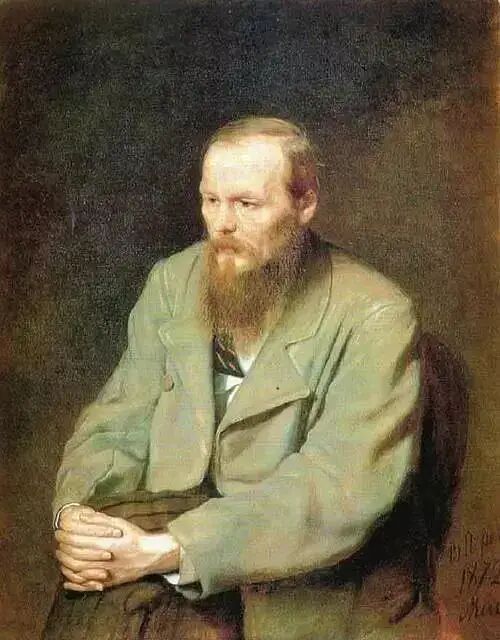
This essay was originally written in 2017 and published in 289 Art & Fashion. Copyright belongs to the magazine.
1
Let us begin with what may be the greatest monologue in the history of literature. Let us suppose the monologue has four syllables, each refracting a moment in its great author's life. When we tell a person's life, can we do more than stammer through several moments?
At the beginning of the monologue, its first syllable, Ivan Karamazov—the man possessed by a devil in Dostoevsky's novel—creates a book within the book: The Grand Inquisitor. At once, the story leaves cold, alcohol-scented Staraya Russa for the burning square of sixteenth-century Seville. The fires that consume heretics are still alight. Here, the Son of God descends to earth once more.
He comes "silently and without display," yet everyone recognizes him and gathers around. He walks wordlessly through the crowd. Blind old men see again. A dead child rises from her coffin. Weeping, people kiss the ground across which he passes. But a cardinal passing by—the Grand Inquisitor, nearly ninety—has him seized and taken to a gloomy, vaulted prison.
"Is it you? You?" the old judge says. "Do not answer. Do not speak... Why have you come to interfere with us? I do not know whether you are that man. But tomorrow I will judge you and burn you at the stake as the most wicked of heretics. The people kissing your feet today will compete tomorrow to heap coal upon your fire. Do you know that? Yes. Perhaps you do."
The prisoner says nothing.
2
The shots of execution have vanished from the Semyonovsky parade ground. Today, it is covered with paving stones, grass, the footprints of pigeons, and a statue of Chernyshevsky. In the nineteenth century, it was St. Petersburg's place of execution. In the winter of 1849, the twenty-eight-year-old Dostoevsky was among those condemned to die.
From the jolting prison cart, Dostoevsky saw "a sea of people" outside the window, like the crowd gathered in the square in Seville. He had been sentenced to death for taking part in the Petrashevsky Circle, which believed in Fourier and socialism. The executioners dressed the prisoners in white and ordered them to kiss the cross. Then, three to a row, they tied them to black posts. Dostoevsky would be executed in the second group.
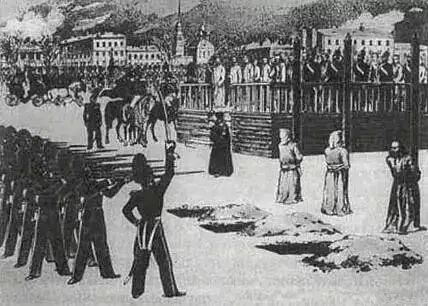
Dostoevsky nearly executed at the Semyonovsky parade ground
No one knows whether he thought of God before death. In a letter to his brother Mikhail, he wrote: "In the moment before death, I thought of you and of everything between us. You, only you, were in my heart. Only then did I understand how much I love you." Yet in a companion's recollection, just before the gunshot, Dostoevsky suddenly turned to Speshnev and said, "We shall be with Christ." He was quoting Victor Hugo's The Last Day of a Condemned Man, and spoke in French: Nous serons avec le Christ. The captivating Speshnev, however, pointed down at the ground. "A little dust," he said, also in French: un peu de poussière.
This predicament ran throughout Dostoevsky's life. Even at its end, he would remain an impure believer, destined to receive no special favor from salvation. His voice was always being challenged—first by friends, later by the devil crawling within him. Here was the proud Speshnev, his materialist comrade. What did he care for Dostoevsky's sudden God and vision? In their eyes, Dostoevsky was an arrogant eccentric, a man of nervous sensitivity who lost control at the faintest criticism. At twenty-four, he wrote his first novel, Poor Folk, and became famous overnight, then quickly fell out with Belinsky, the critic who discovered him. Afterward, he drifted among Petersburg's literary circles and could barely feed himself. At twenty-eight, his falling life finally landed on the point of death, yet not one of the companions dying beside him had compassion for his fear or faith. His appeal to Christ became testimony only to Speshnev's serenity. Even before this, he had lived beneath Speshnev's shadow. Dostoevsky borrowed a large sum from him. "Now I am his. I can never repay it, and he will never ask me to. That is the kind of man he is," he confessed to a doctor. "From now on, I have a Mephistopheles of my own."
The Semyonovsky parade ground fell silent, but death did not arrive on schedule. At the final instant, the executioners received a pardon from the tsar, commuting the death sentences of the Petrashevsky members. They would be exiled to Siberia for four years of hard labor. God released Dostoevsky. He would have to go on living as a sinner.
Dostoevsky was born in Moscow in 1821. Napoleon had just died. Ørsted had discovered the relationship between electricity and magnetism. In Russia, four years later, the Decembrists, advocates of enlightenment and freedom, would revolt in St. Petersburg's Senate Square, be suppressed, and be sent to Siberia. An anxious tsar would fill the city and its salons with agents. The serfs would labor without compensation for another forty years.
Dostoevsky's father was a doctor on the outskirts of Moscow who treated the poor. Later, relying on his savings and reputation, he caught the last carriage into the nobility and acquired a small estate and several serfs. Early accounts called him strict and violent, leading many to regard him as the model for the brutal, greedy father in The Brothers Karamazov. In the novel, the father abuses his illegitimate son, competes with his eldest son for women and money, and is eventually murdered, leaving a mystery behind. In real life, Dostoevsky was eighteen when news of his father's death arrived. Neighbors said serfs had killed him while he was drunk. The story became material for Freud. In his famous essay "Dostoevsky and Parricide," Freud declared that Dostoevsky's complex personality arose from his Oedipus complex—his desire to possess his mother and wish for his father's death—and that the guilt of his father's death would remain with him throughout his life.
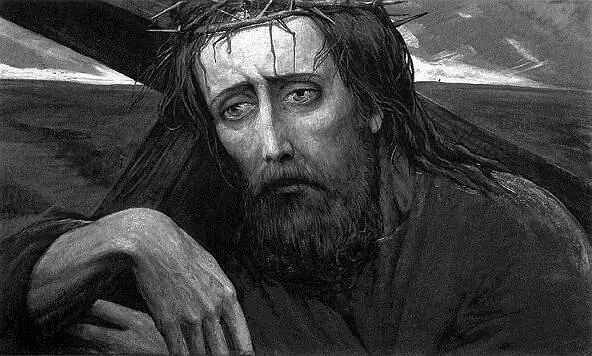
An illustration from The Brothers Karamazov
Joseph Frank, Dostoevsky's biographer, objected. In his biography, he pointed out that there was nothing sordid in Dostoevsky's relationship with his father. The father was strict and devout, and placed great hopes in his children. The mother was a loving woman. As a child, Dostoevsky grew up listening to his parents' nighttime stories: the Bible, Pushkin's poetry, the epics of Homer. His father longed to rise through the classes and borrowed money to send Dostoevsky to a private school. There, the boy felt entirely out of place among aristocratic classmates. As his mother and father died, he grew anxious. He began to discover that he could not control his emotions or his body.
At seventeen, he began to show symptoms of epilepsy. It would torment him for the rest of his life. His first wife would despise him for it. Freud said it was a state closely resembling death. Dostoevsky himself wrote that epilepsy created an "extraordinary tension" in his brain, during which he experienced "infinite ecstasy and the most complete life." In his novels, we repeatedly encounter convulsing, prostrate, feverish figures: Raskolnikov in Crime and Punishment, the underground man in Notes from Underground, Ivan and Smerdyakov in The Brothers Karamazov. They are ugly, their expressions deranged, forever talking with pathological excess. Yet their language is precise and rational, advancing step by step in its deduction of moral nothingness. Dostoevsky shows us without ambiguity that madness has no clear boundary. Everyone convinced of his own reason may become the epileptic at the desk. Everyone is a person in the process of dying.
Bakhtin called Dostoevsky's defining poetics "polyphony": his characters are not governed by a unified authorial consciousness, but exist independently, speak as equals, possess voices of their own. Yet in Dostoevsky's most captivating passages, The Grand Inquisitor among them, polyphony often disappears. In its place, a devil's voice spreads. It is complex, rigorous, all-encompassing, self-affirming, always the winner of the argument. Or perhaps polyphony remains, but the devil's monologue already contains many voices—and suddenly, among them, we always hear our own.
At twenty-eight, on the eve of exile to Siberia, Dostoevsky received a formal diagnosis of epilepsy. Before the gun could fire at Semyonovsky, he had already died many times. Yet it was in Siberia that he was reborn for the first.
3
The old man beside the prisoner keeps asking and answering his own questions.
"Have you the right to reveal the secrets of the world from which you came? No, you have not. You may add nothing to what you said before. Whatever new information you bring will violate people's freedom of belief, though you yourself once said, 'I will make you free'... Now we have finally settled the matter, in your name. For fifteen centuries, we have labored over this freedom." The old bishop means the Inquisition. "Now these people believe more than ever that they possess perfect freedom. They have obediently placed it at our feet... At last, we have abolished freedom and made people happy. Why have you come to interfere?"
"Humanity has no effort more persistent or exhausting than the search for someone before whom to bow. And the object of worship must be beyond dispute, worshiped by everyone, worshiped together... You expected to receive people's love freely given. You replaced the ancient rule with a free heart that would judge good and evil for itself. But the agony of freedom has left the kingdom of the human heart forever without peace. In the end, they will cry out that you do not represent truth, because you have left them in greater bewilderment and pain. You thought too highly of human beings. Though created as rebels, they are unquestionably slaves."
The prisoner says nothing.
4
The road to Siberia was long and hard.
From the Decembrists to Primo Levi, from the katorga of the tsars to Auschwitz, free souls wandered inside cages for a hundred years. From the tsar to Stalin, the labor camp changed hands, while those who endured the agony of freedom continued to arrive. Dostoevsky was one of them.
A century later, Pasternak would describe the journey to Siberia romantically in Doctor Zhivago:
Beyond the train window, spring water spread without end, an endless flooded land. The slow train seemed to glide across its surface. The water was smooth as a mirror and only now and then caught the iron-gray reflection of the passing carriages. Warm sunlight painted glossy circles on the water, like a cook brushing a hot pie with an oil-soaked feather.
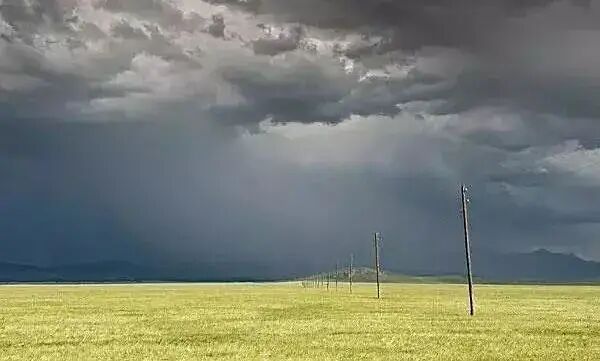
Siberia is a vast region of northern Asia with an extremely harsh climate.
Dostoevsky cared nothing for such scenery. Unlike his Russian contemporaries, he never made nature an object of devotion. Nature could not reconcile him to fate. His eyes focused on human-made cages and ruined streets. In the cold prison camp at Omsk, the soup contained "not one scrap of meat, but cockroaches floated in it." Everyone wore shackles, had his head shaved and marked, a sign of the criminal's inferiority. Omsk now has a statue of Dostoevsky, as though the city's torture of him were something worth commemorating. In the statue, Dostoevsky walks with his head lowered, wearing a robe. Across his body lie the wounds of snowstorms and whips.
Yet none of those wounds drove him to despair. What did was the collapse of his former faith. He, too, had been an ardent socialist and believed that the Russian "people" suffered under a guilt that could not be dispelled—eradicate this groundless guilt, and people would be free! But in Omsk, he watched serfs commit grave evil and think nothing of it. The people tormented by guilt in his imagination were the opposite of those in the labor camp. "Dostoevsky did not merely burn everything he had once revered; he trampled it in the dust," Shestov wrote. "He did not merely loathe his former faith. He despised it."
If real people were like this—selfish, shortsighted, always shamelessly proud of the wrong they had done; if they always rushed to pile coal on the martyr's pyre and, even in chains, kicked the zealous righteous man while he was down—did they deserve to be saved? Should their ropes be loosened, should the meat be taken from the mousetrap, if freedom would only leave them "in greater bewilderment and pain"? The question hangs over all of human history: from Jesus's cross to the prison in fifteenth-century Seville, to frozen Omsk, to the Bolsheviks before the Winter Palace with everything waiting to be rebuilt, to the collapse of the Soviet Union. The question remains new. History has never answered.
Dostoevsky, however, had his own answer. His transformation occurred in a single instant.
It was the eve of Easter at Omsk. Dostoevsky wandered through the prison camp. With the holiday approaching, the serfs had drunk themselves insensible and lay in disordered heaps on the ground. Never had his heart been so "filled with hatred." He rushed impatiently out of the camp. There he met a Polish prisoner who regarded the scene with equal contempt. "He looked at me darkly, his eyes flashing, his lips trembling," Dostoevsky wrote. "Through clenched teeth, in a voice almost throttled, he said, 'I despise these brutes,' and left."
We know this episode from Dostoevsky's autobiographical story "The Peasant Marey." Of whom was the Pole speaking? Perhaps he still saw Dostoevsky as an ally. They were men of culture and education; they did not indulge themselves as slaves to desire. But Dostoevsky did not go with him. He returned to the camp. At that moment, he suddenly remembered an entirely ordinary instant from childhood—
It was a winter day when he was nine, and he was walking on his father's country estate. Suddenly, he heard someone in the bushes shout, "A wolf!" Terrified out of his mind, he screamed and ran toward a serf plowing the field. A peasant named Marey held him. "Look at you, so frightened. Oh dear." Like a mother, he comforted the young Dostoevsky and made the sign of the cross over him. On the road home, each time the timid boy looked back, Marey still stood in the distance and waved, until even his face blurred.
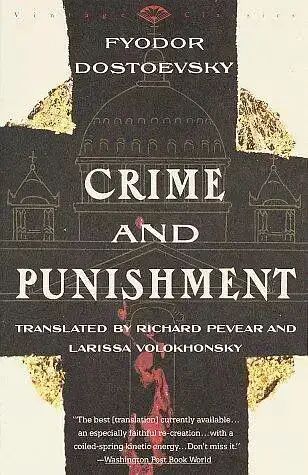
Crime and Punishment
Remembering this, Dostoevsky discovered that "a faint smile from the memory still rested on my cheek." Such moments are rare. In his novels, people are either mad or ecstatic. Yet from that instant onward, he looked with entirely different eyes at the serfs singing hoarse drunken songs in the corner—because he knew that any one of them might be a potential Marey.
Dostoevsky's answer was born at that moment and never changed: so long as a person retains the possibility of doing good, however grave his sins, he deserves to be saved. He is worth another person's life. Likewise, if the building of a perfect city requires the sacrifice of one simple, ridiculous person, "then a true Russian will make this choice: let me be the one deprived of happiness," Dostoevsky said in his Pushkin speech during the final year of his life. "For I cannot obtain happiness upon the destruction of another."
This was Dostoevsky. In the years after hard labor, he was irascible, hesitant, jealous, coldhearted, addicted to gambling. Nor did he, like Tolstoy and Turgenev, labor to portray substantial and noble Russian souls in forests and on battlefields. He moved through the dark streets of St. Petersburg, listening to the babble of beggars, drunks, epileptics, and madmen. He became the Russian in the sewer. But he believed in no promise of a manufactured heaven. He did not fear the agony of freedom. And he never regarded people as slaves.
In Crime and Punishment, the saintly prostitute Sonya hears Raskolnikov confess to murder and, weeping, embraces him. "Go to the crossroads," she says. "Bow to the people and kiss the earth, because you have sinned against it. Then tell the whole world aloud: 'I am a murderer!'" Sonya's answer is not clever. Before the aggressive Raskolnikov, it even seems clumsy, as if it has nothing to say to his theory that an "extraordinary man" may kill without consequence. Yet in the end, Raskolnikov truly walks trembling toward the crossroads. What makes reason suddenly unable to withstand him? What fills him in that moment with "joy and happiness"? He drops to his knees in the middle of the square, bows his head to the ground and kisses it, rises, then kneels and bows again.
The crowd gathers around him, as it gathered around Jesus in the nineteenth century.
"Look, he's drunk!" a young man says.
"Is he going to Jerusalem?" says a drunken townsman.
"And a gentleman, too," someone says.
"These days, who can tell a gentleman from anyone else?"
5
"A terrible and intelligent spirit, the spirit of self-destruction and the negation of existence. This great spirit spoke to you in the wilderness. Through three questions, he revealed himself to you, though the Gospel calls them 'temptations.'" The old man speaks without pause.
"The first question: you came empty-handed, bearing only the promise of freedom. But for human beings and human society, nothing is more unbearable than freedom! Look at the stones in the wilderness. If you had turned them into bread, humanity would have followed you like a grateful flock. But you refused the suggestion. You thought: if obedience is purchased with bread, how can it be freedom? You said man cannot live by bread alone. But do you know that, for the sake of earthly bread, the spirit will rise against you and defeat you? Everyone will follow him and cry: 'Who is like unto this beast? You brought us fire from Heaven!' Centuries later, people will invent: 'Once food and clothing are sufficient, people know honor and shame!' They will oppose you and destroy your temple. Upon the ruins, the terrible Tower of Babel will rise again. Though this one, like the last, will never be completed."
The prisoner says nothing.
6
In 1862, Dostoevsky saw the Tower of Babel for the first time.
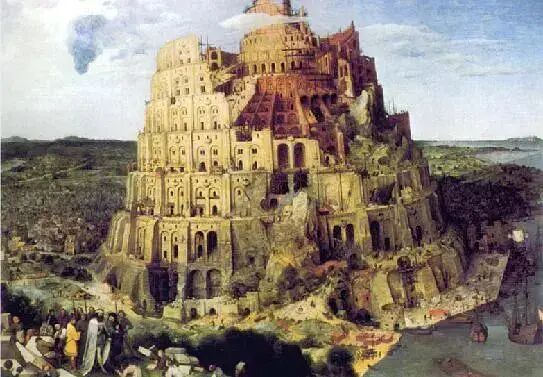
Genesis 11 in the Old Testament says the Tower of Babel was built by a united humanity in the hope of reaching Heaven.
It was London's Crystal Palace, an immense building of glass, a nineteenth-century wonder, its steel frame holding up every imagination of the future. "Look at the million people swarming there in humble submission. You feel that some final judgment has taken place, that something has reached its conclusion," Dostoevsky wrote. "It is as if the prophecy of Revelation has been fulfilled. You feel that immense and enduring spiritual strength is required not to surrender to it, to deny your impression, not to bow; to refuse to deify the demon—that is, not to take the material world as your ideal."
In one sense, the Tower of Babel had been completed. Later generations would praise it and treat it as the beginning of an era. Afterward, Robert Moses laid highways across New York; Dubai's Burj Khalifa declared itself the tallest building in the world. Yet every newcomer standing before a skyscraper, like Dostoevsky, hears the cheers of the victor and feels a faint, undefined fear.
In Baden-Baden, Dostoevsky met Turgenev. The two did not admire one another. In a letter to Maykov, Dostoevsky complained that Turgenev called himself more German than Russian. It felt like betrayal. As the son of a Europeanized aristocrat, Turgenev appeared to believe that the answer to Russia's nihilism and crisis of modernization lay in the Western European Enlightenment. By then, Dostoevsky was hostile to the Enlightenment and all its products, socialism included. Turgenev's humanism seemed to him an affectation. In one essay, Turgenev described the immense discomfort he felt at the sight of a firing squad carrying out an execution, a discomfort that finally made him turn away. This enraged Dostoevsky. "No one," he wrote, "has the right to turn away from what is happening in the world."
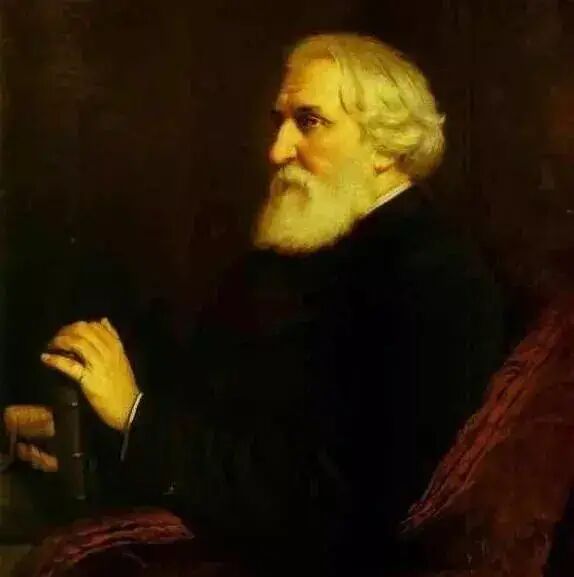
Ivan Sergeyevich Turgenev, nineteenth-century Russian critical realist novelist, poet, and playwright, known as a “master of realist art.”
He failed to get along with most of his contemporaries. He called the novels of Tolstoy and Turgenev "the literature of the aristocratic landowner," yet swallowed his pride and asked Turgenev for gambling money—which he never repaid. No one who lent him money came to a good end. Speshnev and Turgenev were both written into Demons as models for modern sophists. His epilepsy grew worse. He could not support his dead brother's family or satisfy the greed of his widow's stepson. Yet at the gaming table, he remained unable to control himself. One second he repented bitterly; the next he adorned his own failing: "I merely tend to push everything to its limit." He was a Lacanian patient, fully aware of his symptom and yet enjoying it, living in symbiosis with it. His sickness was conscience and greed. He longed simultaneously for freedom and earthly bread. Both brought misfortune, but the great moments of his literature were born from that misfortune.
The great writer's life, however, was not wholly filled with unhappiness. On October 4, 1866, he met Anna.
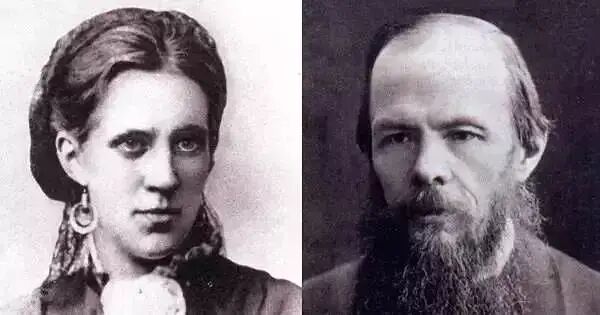
Anna and Dostoevsky
Our writer was forty-five, surrounded by poverty and debt. Anna had just turned twenty and worked as a stenographer. She entered his study. Dostoevsky gave her a dictation test, then offered her a cigarette. She refused it. J. M. Coetzee says this meant Anna passed the second test: she was not a liberated woman of the age and therefore probably not a nihilist either. Their partnership produced results at once. Anna became his muse, and Dostoevsky completed The Gambler in a month. At the same time, he sensed the birth of a sincere feeling he had not known for years. He paced the room and, in pauses between dictation, asked Anna what she thought of his female characters. He said he was planning a new novel in which an old painter would propose to a young woman. Could so young and different a woman possibly love the old painter too? "Now put yourself in her place," he told her. "Imagine I am the painter. I confess my love and ask you to become my wife. What would you answer?" Anna said, "I would say that I love you. And that I will love you forever."
They married three months after meeting. He appears not to have told Anna about his epilepsy. During the wedding, he suddenly collapsed in a seizure. The young Anna did not panic. She held his mouth, protected his tongue, and did not punish him afterward; she behaved the same way for the rest of his life. Toward his gambling, she showed measureless patience. She pawned her jewelry and guarded the family's money; he stole it and went out to gamble. When he returned, he beat his chest and wailed, "I do not deserve you. I am a pig, and you are an angel." She merely listened gently. Naturally, they also played the games of mutual torment found in love. Dostoevsky was jealous whenever Anna spoke to any man. Anna enjoyed his jealousy and deliberately showed him her correspondence with other men. He locked his hands around her throat and nearly suffocated her.
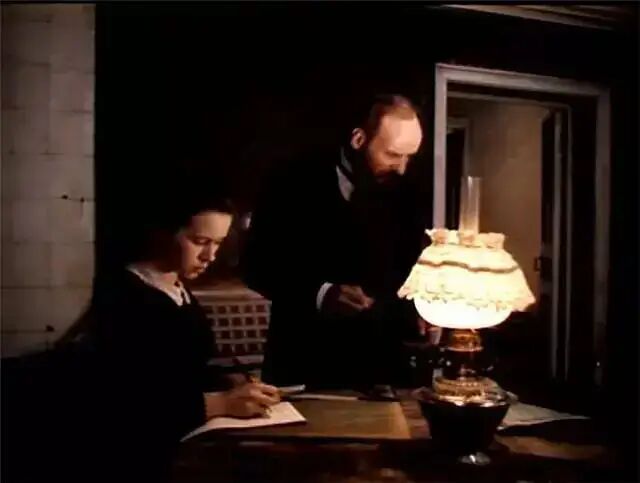
Anna taking Dostoevsky's dictation (film still)
When they first met, Dostoevsky was still writing the unfinished Crime and Punishment, of which two installments had already appeared. Just as he successfully foretold the breakdown of modernity, he foretold his own fate: the saintly prostitute Sonya would descend into the life of the sinner Raskolnikov, and Anna became, in every sense, Sonya's reflection in reality. She was young, but kind, forgiving, firm. She brought light without requiring superfluous words. In Geneva, Anna gave birth to their first daughter, whom they named Sonya. Three months later, Sonya died of pneumonia. Anna said Dostoevsky wept like a woman without hope.
As Anna rooted herself within Dostoevsky's unhappy life, he seemed to acquire an answer to the Tower of Babel. The tower would not fall, and none of the questions on it could be answered. The politicians and architects gathered at its summit and shouted: why can we not become taller, faster, stronger? Would not acknowledging the naturalness of self-interest bring happiness to the greatest number? Do we not live in an age that, as history ends, must finally rise without limit? Anna and Sonya could not answer these questions. All they could do was persist in their faith. Yet faith alone was enough to make the great tower tremble.
7
"We have borne their sins for the sake of their happiness," the cardinal says. "We will stand before you and say, 'Judge us, if you can, if you dare.' Know that I do not fear you. Know that I, too, went into the wilderness. I, too, ate locusts and roots. I, too, once treasured the freedom with which you blessed humanity and longed to join the ranks of your chosen, to become one of the strong. But I awoke and refused to serve madness any longer. I left the proud and strong. I intend to benefit the meek. I tell you once more: tomorrow you will see that meek flock. At one movement of my hand, they will compete to heap hot coals upon the pyre. I will burn you there because you came to interfere with us. Tomorrow, I will burn you. I have finished."
When the old man finishes, he waits to see how the prisoner will answer. But the prisoner's silence embarrasses him. He wants the other man to say something, "even something bitter and terrible."
But the prisoner merely walks up to him, kisses him gently on the lips, then silently departs.
8
At 8:36 p.m. on February 9, 1881, Dostoevsky's life came to its end. His young daughter wrote on a matchbox: "Today, Papa died."
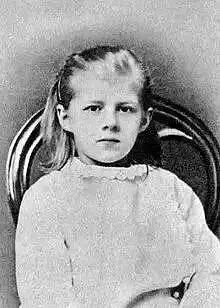
Dostoevsky and Anna's daughter
Philip Rahv said that Dostoevsky continued struggling with atheism until the final moment of his life. This was because two people had always lived inside him: a devout Christian and an atheist.
The Brothers Karamazov was his final work. The Grand Inquisitor was his account of himself. He was not only the devil in it, but the prisoner too. For precisely this reason, it is unfair when people say Dostoevsky's riddles are more profound than his answers. Only the devil wants to argue. Jesus merely listens—and forgives him.
In the last year of his life, he delivered his famous Pushkin speech in Moscow. At the end, he said: "Pushkin revealed the universality of the Russian spirit. Had he lived longer, perhaps we could have explained our aspirations to the Europeans more clearly, and perhaps there would have been less misunderstanding between us. But God saw otherwise. Pushkin died at the moment of his greatest maturity and strength. He carried the great secret into his grave. Now, without him, we will go in search of that great secret." At the end of the speech, the entire audience was swept up. Turgenev came forward and embraced him. Their enmity dissolved.
Throughout his life, Dostoevsky longed to tell the world the shape of that hidden Russian spirit. In the 1860s, he said, "The Russian idea is preparing a great renewal throughout the world... and it will happen within a century—this I fervently believe." Of his many prophecies, this may have been the least fulfilled. A renewal did happen, but it was the opposite of what he imagined: Russia was first to tear down the altars of the gods.
The Brothers Karamazov was to be the first part of a trilogy. He named its pure protagonist Alyosha after his son who died young. He gave the ugly Smerdyakov his own first name as a patronymic. In his imagination, the trilogy had an overarching title: The Life of a Great Sinner.
Kierkegaard said existence has three stages. At the highest, religious stage, a person finally discovers that he is both a sinner and a child of God. The great sinner of the trilogy was Alyosha, and also Dostoevsky himself. They were simultaneously sinners and sons of God. At the end of The Brothers Karamazov, Alyosha tells the children gathered around him: "First we must be kind, then honest, and then never forget one another... We shall certainly rise again. We shall certainly see one another and tell each other, gladly and joyfully, everything that happened."
And so, let us try not to make death the endpoint of the four moments in Dostoevsky's life. Let us imagine that the clock did not stop at 8:36, but went on moving. Let us suppose that, when the prisoner left the prison in Seville, he did not return directly to Heaven, but continued walking through the human world. People ask him: can we truly be free? Have we gone too far? Why do our sufferings return again and again, so little changed? Gradually, people can no longer recognize the face he wore twenty centuries before. Yet he sees them. He kisses gently every person who believes and every person who does not.
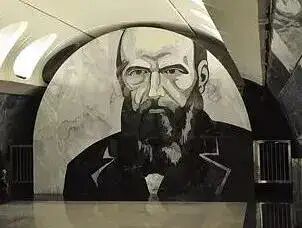
Dostoevskaya metro station, built after the collapse of the Soviet Union